

Improving your financial literacy is really about one thing: building the skills and confidence to make smart money decisions for your family's future.
It all starts with a clear-eyed look at where you are today. From there, you learn the core ideas—like budgeting and investing—and turn that knowledge into consistent, lifelong habits. This whole journey is less about complicated formulas and much more about gaining clarity and control over your own life.
Your Journey to Financial Clarity Starts Now
Financial literacy isn't some destination you arrive at overnight. Think of it as a continuous journey of learning and growth, an empowering skill that serves you at every single stage of life.
Whether you're a young professional just starting your career, a parent managing a busy household, or a grandparent focused on leaving a lasting legacy, the principles of smart money management are universal. This guide is built on a simple idea from Paul Mauro’s 50+ years of experience: financial wisdom comes from clarity, not complexity.

So many people avoid their finances because they feel overwhelmed by Wall Street jargon or intimidated by past mistakes. But true financial well-being begins the moment you decide to face your finances with curiosity instead of fear. The goal here is to build a solid foundation of knowledge that gives you the confidence to act.
The Emotional Side of Money
Let's be honest: money is rarely just about numbers on a spreadsheet. It’s deeply connected to our emotions. It represents security, freedom, opportunity, and sometimes even our self-worth. Understanding how to improve your financial literacy means acknowledging this emotional side of the coin.
The real reward of financial literacy isn't just a bigger bank account. It's the profound peace of mind that comes from knowing you have a plan, that you are in control, and that you can provide for the people you love.
This guide will help you move from a place of anxiety to one of calm confidence. By framing your financial decisions around your core values—like family security or personal freedom—you create a powerful motivator to stay the course when things get tough.
What You Will Learn in This Guide
We’re going to lay out a clear, actionable roadmap to build your financial knowledge from the ground up. You absolutely do not need a degree in finance to master these concepts.
Here’s what we’ll cover:
- Assess Your Starting Point: Get a clear, judgment-free picture of your current financial health.
- Master Core Concepts: We'll demystify budgeting, saving, debt, and investing with simple, practical explanations.
- Build Lasting Habits: Learn to turn knowledge into action with routines that make smart financial decisions second nature.
- Share Your Wisdom: Discover how to teach these essential skills to your children and have productive conversations about finances with aging parents.
Try to think of this guide not as a chore, but as the first step toward building true, lasting wealth for yourself and your family. Your journey to financial clarity starts right now.
Understanding Your Financial Starting Point
Before you can map out a new financial direction, you have to know exactly where you’re standing. Think of it like a GPS: it can’t give you directions until it finds your current location. The same is true for your money. To get anywhere, you need a clear, honest, and judgment-free picture of your finances right now.
This isn’t about judging past decisions. It’s about gaining clarity so you can make powerful, informed choices from this day forward. It all starts by answering two simple questions: What do you own, and what do you owe?
Calculating Your Net Worth
Your net worth is the clearest single number that shows your financial position. It’s simply the total value of your assets (everything you own) minus your liabilities (everything you owe). It’s your personal balance sheet, and it’s surprisingly easy to figure out.
Grab a notepad or open a spreadsheet and start by listing your assets.
- Cash and Savings: Tally up what's in your checking and savings accounts, plus any cash on hand.
- Investments: Note the current value of your retirement accounts (like a 401(k) or IRA) and any brokerage accounts.
- Real Estate: Use a tool like Zillow or Redfin to get a realistic market value for your home or other properties.
- Valuable Property: Add the estimated value of your cars, jewelry, or any other significant possessions.
Next, it’s time to list your liabilities.
- Mortgage: Write down the remaining balance on your home loan.
- Other Loans: Include what you still owe on car loans, student loans, or personal loans.
- Credit Card Debt: Add up the outstanding balances on all your credit cards.
Now for the final step: subtract your total liabilities from your total assets. That number is your net worth. It might be positive, it could be negative—it doesn’t matter. This is just your starting line.
Tracking Your Cash Flow
While net worth is a snapshot, your cash flow is the movie of your financial life. It’s the money moving in and out each month, and it reveals the habits and patterns that created your current reality. Seeing it is the first step to changing it.
For the next 30 days, commit to tracking every single dollar you spend. This isn't about budgeting or cutting back—not yet. It’s purely an exercise in awareness. You can use an app like Mint, a simple spreadsheet, or even a small notebook you keep in your pocket.
A busy parent I worked with was floored to see how much they were spending on takeout during hectic weeknights—it was a real eye-opener. Another client, a retiree, noticed a clear pattern in medical co-pays that helped them create a much more predictable healthcare budget. The goal here is discovery.
Awareness is the first step toward control. You cannot change what you do not acknowledge, and tracking your cash flow is the most effective way to see your financial habits in black and white.
This simple act of observation will shine a light on unconscious spending and immediately show you where you can make changes. It’s the foundation for every smart financial decision you’ll make from here on out.
Pinpointing Your Knowledge Gaps
The final piece of this assessment is figuring out where to focus your energy. Financial literacy is a huge topic; nobody is an expert in everything. Honing in on your specific knowledge gaps makes the learning process faster and far more effective.
Take a moment and think about which of these areas feels the most confusing or intimidating to you:
- Creating a budget that you can actually stick to.
- Building a real strategy to get out of debt for good.
- Understanding how to start investing for retirement.
- Choosing the right insurance to protect your family.
- Learning the basics of estate planning or saving for college.
Being honest about what you don’t know is a sign of strength, not weakness. It gives you a personalized roadmap for your financial education. If debt is your biggest stressor, that’s where you start. If you’ve mastered budgeting but investing feels like a foreign language, you’ve just found your next topic. This targeted approach ensures you're learning exactly what you need to know, right now.
Mastering the Core Pillars of Personal Finance
Once you’ve taken a good, honest look at where you stand financially, it's time to build your knowledge. Improving your financial literacy isn't about memorizing jargon or becoming a stock market wizard overnight. It's about really understanding a few core concepts that dictate how money flows through your life.
When you grasp these pillars, you gain the confidence to make smart financial decisions, not just once in a while, but consistently. Think of them as the essential tools in your financial toolkit. You don't need to master everything at once, but getting comfortable with each one will empower you to handle just about any financial curveball with a lot more calm and clarity.
Budgeting as a Tool for Freedom
So many people hear the word "budget" and immediately think of restriction—a financial diet that squeezes all the joy out of life. In my experience, a good budget does the exact opposite. It's a tool for freedom.
A budget is simply a plan that gives every single dollar a job. It makes sure your money is working toward what you truly want, whether that's saving for a family vacation, crushing debt, or building a nest egg for retirement. It's about telling your money where to go instead of scratching your head and wondering where it all went.
For instance, I once worked with a young couple who felt like they were spinning their wheels. By tracking their spending, they realized that the small, unconscious purchases—daily coffees, lunches out—were adding up. By redirecting that money, they could easily fund their down payment goal within three years. That’s not restriction; that’s taking control.
The Power of Compound Interest
I’ve heard that Albert Einstein called compound interest the eighth wonder of the world, and after 50 years in this field, I have to agree. It's the magic that happens when the interest you earn starts earning interest of its own, creating a snowball effect that can build incredible wealth over time.
This concept is the real engine behind long-term financial success. Understanding it is non-negotiable.
Let's imagine two friends who start saving for retirement at age 25:
- Friend A saves $200 a month until they're 65.
- Friend B waits until 35 to start, but to catch up, they save $400 a month.
Assuming an 8% annual return, Friend A will end up with significantly more money at retirement, even though they saved less out of their own pocket. Why? That extra decade of compounding did all the heavy lifting for them. This is exactly why I tell everyone: start early, even if it's with small amounts. It's one of the most powerful financial moves you can ever make.
Understanding Good vs. Bad Debt
Not all debt is created equal. One of the most crucial skills you can develop is learning to tell the difference between "good" debt and "bad" debt. It’s the key to building wealth and avoiding financial traps that can hold you back for years.
Good debt is an investment in something that has the potential to grow in value or increase your future income. Think of a mortgage on a home that appreciates over time, or a student loan that leads to a high-paying career.
Bad debt, on the other hand, is usually for things that lose value the moment you buy them. This is your high-interest credit card debt from discretionary spending or personal loans for luxury items. The very first step toward financial health is making a simple, aggressive plan to wipe out your bad debt. Doing so frees up your cash flow for things that actually build your future, like saving and investing.
Demystifying Investing
Investing can feel incredibly intimidating, but at its heart, the concept is simple: you’re making your money work for you. The whole point is to put your capital into assets that have the potential to grow over time, outpace inflation, and build real, lasting wealth for your family.
You don’t need a Ph.D. in economics to get started. You just need to understand a few basic principles.
This infographic gives you a great visual of the key areas to look at before you even think about putting a dollar into the market.
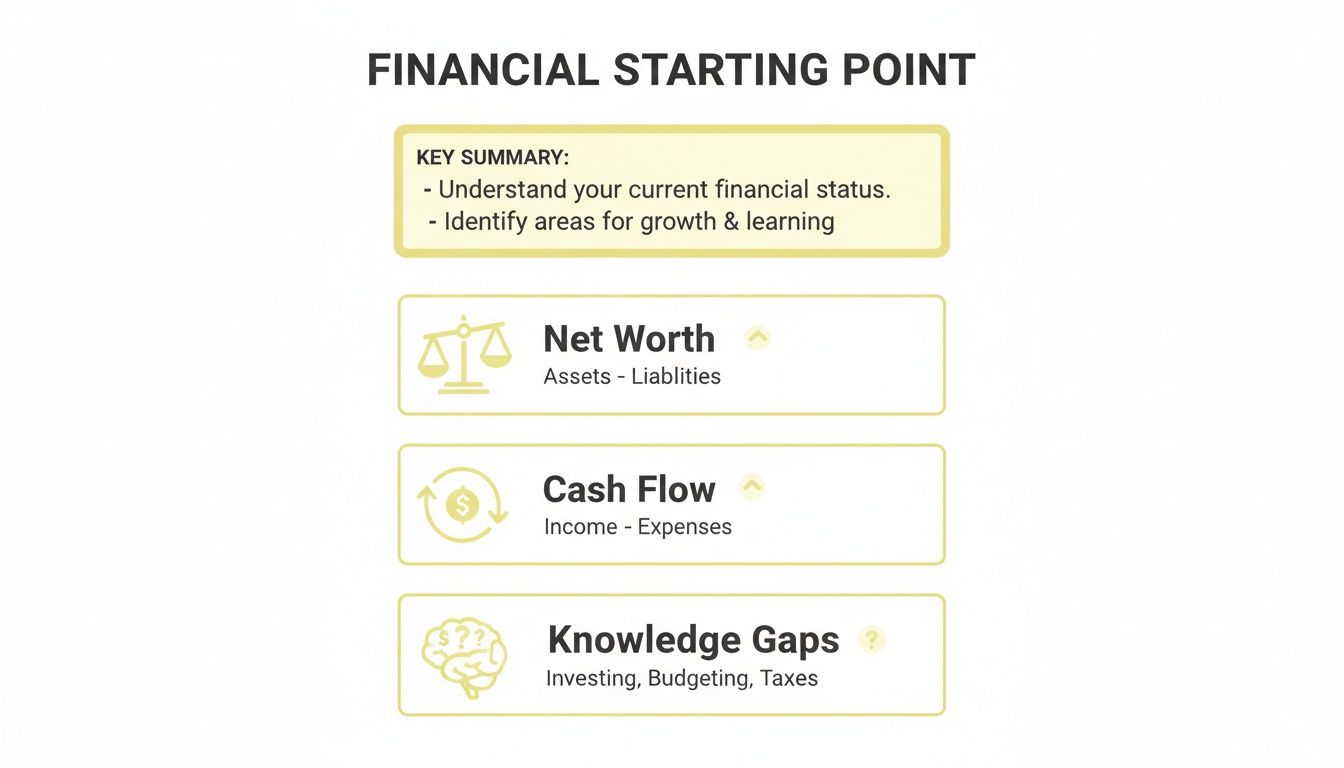
It’s a fantastic reminder to get a handle on your net worth, your cash flow, and what you don't know yet. This is the foundation you'll build everything else on.
From there, you'll want to get familiar with a few key ideas:
- Risk Tolerance: This is all about knowing yourself. How much market volatility can you stomach without panicking? Your answer will shape your entire investment strategy.
- Diversification: You’ve heard the saying, "don't put all your eggs in one basket." That's diversification. Spreading your investments across different things (like stocks and bonds) helps manage risk.
- Long-Term Goals: Investing is a marathon, not a sprint. Your strategy should always be tied to your long-term goals, whether that's retiring comfortably or paying for a child’s education down the road.
For anyone just starting out, we've put together a straightforward guide on how to start investing for beginners that breaks these initial steps down even further.
To really bring these concepts together, here is a simple way to think about the four main pillars of financial literacy.
Four Pillars of Financial Literacy
This table summarizes the core concepts every individual should understand to build a solid financial foundation.
| Pillar | What It Means for Your Family | First Actionable Step |
|---|---|---|
| Budgeting | Knowing exactly where your money goes so you can direct it toward your goals. | Track your spending for 30 days to see your real cash flow. |
| Compounding | Your money earns money, creating a snowball of wealth over the long term. | Open a retirement account (like an IRA or 401k) and start contributing, even if it's small. |
| Debt Management | Differentiating between debt that builds assets and debt that drains your wealth. | Make a list of all your high-interest debts and create a plan to pay off the smallest one first. |
| Investing | Putting your money to work in assets that can grow and beat inflation. | Define one long-term financial goal (e.g., retirement in 20 years) to give your investing a purpose. |
Mastering these pillars isn't just about numbers; it’s about building a secure and intentional life for yourself and the people you care about.
Building Smart Financial Habits for a Lifetime
Knowing the difference between a stock and a bond is one thing. Actually turning that knowledge into automatic, real-world behavior? That’s where the magic really happens. The path to financial literacy isn't just about learning; it's about building smart habits that stick.
This isn’t about some massive, overnight financial overhaul. It’s about small, consistent actions that quietly compound over time. Think of these habits as the bedrock of your financial future, turning abstract goals into something you can actually see and feel. The key is always consistency, not perfection. A few simple routines you actually stick with will do far more for your financial health than some complicated system you abandon after a week.
The Weekly Money Check-In
One of the most powerful habits any couple or family can adopt is the Weekly Money Check-in. This is nothing more than a short, dedicated time—maybe 15-20 minutes—to calmly go over your finances together. No blame, no stress. The goal is simple: communication and getting on the same page.
During this quick chat, you can:
- Glance at the week ahead: Any big bills due? A birthday coming up? Planning ahead avoids surprises.
- Track your progress: How’s the monthly budget looking? A quick peek keeps you on course.
- Celebrate the small wins: Did you nail the grocery budget or hit a small savings goal? Acknowledge it!
This simple ritual takes the tension out of money talks. It transforms finance from a taboo topic into a normal part of your weekly routine, right up there with planning meals or coordinating schedules. Over time, this builds a powerful sense of teamwork.
Automate Your Financial Life
Honestly, the single most effective way to "pay yourself first" is to take yourself out of the equation. Automation is your best friend when it comes to building wealth because it works tirelessly in the background, making sure your most important financial goals are always met.
Start by setting up automatic transfers right from your checking account.
- Savings First: The day you get paid, have a set amount automatically whisked away to your high-yield savings account. We talk more about building that safety net in our emergency fund checklist.
- Invest on Autopilot: Do the same for your retirement or brokerage accounts. Even small, consistent amounts grow into something significant over time, thanks to the power of compounding.
- Chip Away at Debt: If you’re fighting high-interest debt, automate an extra payment—even just $25 a month. Every little bit helps.
When you automate these moves, you start treating your savings and investments like non-negotiable bills, just like your rent or mortgage. You’ll be stunned at how fast your accounts grow when you aren't relying on willpower alone.
Embrace Technology Wisely
There are some incredible tools out there to help you manage your money, but it's easy to get overwhelmed. The trick is to pick one or two that actually simplify your life, not complicate it. A good budgeting app, for instance, can categorize your spending for you, saving you hours of tedious tracking.
These tools can give you real-time feedback on your financial health, making it easier to spot trends and adjust your spending. But you also have to be mindful. The same apps that make investing easy can also encourage impulsive trading. Use technology as a tool for awareness, not as a substitute for a thoughtful financial plan.
Imagine sharing stories from 50+ years of smart financial decisions with your grandkids, knowing a small boost in literacy could secure their future. While only about 33% of the U.S. population is financially literate, raising that to 50% could boost GDP growth by half a percentage point by 2029. This isn't just a number; it's the difference between families burdened by debt and those building lasting wealth. As you can discover in recent global financial research, even a minor increase in financial knowledge dramatically cuts household loan defaults and debt ratios.
Overcoming Emotional Hurdles
Let’s be real: building new habits often means confronting old emotional patterns. For a lot of people, impulse spending is a reaction to stress or boredom. For others, just looking at their bank account brings on so much anxiety that they avoid it altogether. Tackling these emotional triggers is a huge part of this journey.
If you’re an impulse shopper, try the 24-hour rule. For any non-essential purchase over a certain amount, say $50, just wait a day. This cooling-off period gives you time to decide if you truly need the item or if you're just reacting to a fleeting feeling.
And if you’re someone who practices financial avoidance? Start small. Make it a goal to simply log in to your bank account once a day for a week, without doing anything else.
These gentle strategies help rewire your brain's response to money, slowly replacing anxiety with a sense of calm control. By weaving these smart, consistent habits into your everyday life, you aren't just managing money—you're building a foundation for lasting financial peace.
Passing on Financial Wisdom Across Generations
True wealth isn't measured in dollars and cents. It's found in the values, confidence, and wisdom you pass down. When you become the family steward of financial knowledge, you leave one of the most powerful legacies imaginable. Money transforms from a source of conflict into a tool for security, responsibility, and empowerment for everyone you love.
This all starts by meeting people where they are. Financial conversations with a six-year-old look completely different than with a teenager heading off to college or an aging parent navigating retirement. The goal, however, is always the same: foster open, honest communication and build a multi-generational foundation of financial well-being.
Teaching Young Children the Basics
For the youngest members of your family, financial literacy has to be simple and tangible. Abstract ideas like investing or interest rates just won't stick. Instead, you need to focus on hands-on activities that make money real.
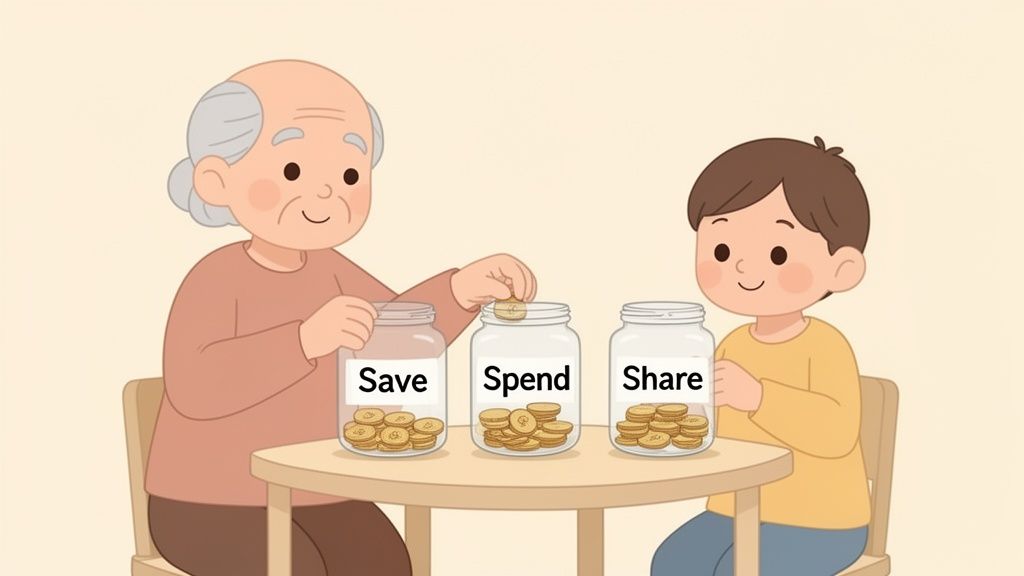
The classic three-jar system is a perfect place to start. Just grab three clear jars and label them: Save, Spend, and Share. Whenever your child gets money, whether from an allowance or a birthday gift, guide them to split it up among the jars. This simple ritual teaches profound money principles:
- The Spend Jar shows them how to make choices and that money is a finite resource.
- The Save Jar introduces delayed gratification, proving how small amounts grow to afford a bigger goal, like a new toy.
- The Share Jar instills the value of generosity and thinking of others—a core piece of a healthy relationship with money.
This hands-on method builds a strong, positive foundation for every financial lesson to come. For more detailed strategies, you can check out our complete guide on how to teach kids about money.
Guiding Teenagers Toward Financial Independence
As kids morph into teenagers, the money conversations have to evolve right along with them. Now is the time to bring in more complex topics that will hit them square in the face very soon. Talking about the cost of a first car, student loans, or the basics of long-term investing can feel intimidating, but it's absolutely crucial.
A great way to break the ice is by involving them in real-world financial decisions. If they get a part-time job, help them open their first checking account and show them how to track their balance. Talk openly about the family budget for things that directly affect them, like groceries or the cell phone bill. When you're transparent, you demystify money and empower them to make smart choices when they're finally on their own.
Money sends messages. By teaching your children and grandchildren how to manage it wisely, you're sending a message of trust, capability, and empowerment that will echo throughout their lives.
Navigating Sensitive Adult Conversations
Talking about money with adult children or aging parents requires a different kind of skill—one rooted in sensitivity and respect. These conversations often touch on deeply personal topics like estate planning, inheritance, and the potential need for long-term care. Kicking them off can feel awkward, but avoiding them is a recipe for confusion and conflict down the road.
Try framing these discussions as being about honoring wishes and ensuring everyone is cared for, not just about the money itself. For instance, instead of asking, "What's in your will?" you could say, "I want to make sure we're all prepared for the future. Can we set aside some time to talk about your plans so I can understand how to best support you?"
The goal is to create a collaborative atmosphere where everyone feels heard and respected. These conversations ensure that financial transitions are handled smoothly, preserving both family wealth and family harmony.
Common Questions About Financial Literacy
Jumping into the world of personal finance can bring up a lot of questions. That’s perfectly normal. It’s a mix of curiosity and maybe a little bit of uncertainty. Let's tackle some of the most common concerns we hear from people just like you, with clear answers that tie back to building a truly smart financial lifestyle.
Feeling overwhelmed isn't a sign to stop. It's a sign you're taking this seriously. The trick is to break the journey down into smaller, more manageable pieces.
Where Should I Start If I Feel Completely Overwhelmed?
Pick one thing. Just one. That feeling of being overwhelmed usually comes from trying to tackle everything at once. Instead, find a single, small action that feels doable right now.
For most people, the best first step is to simply track their spending for a week. No judgment, no big changes. Just grab a notebook or a simple app and see where your money is actually going. This one act creates awareness and gives you the clarity you need for the next step, which is usually putting together a basic budget. It’s a perfect example of Paul Mauro’s principle of 'Clarity Over Complexity.' The goal isn’t a flawless spreadsheet on day one; it’s just getting a clearer picture of your financial reality.
This simple exercise shifts your whole mindset from anxious avoidance to empowered observation.
What Are the Most Reliable Resources for Learning?
Stick to reputable, unbiased sources that are more interested in educating you than selling you something. Government sites like the Consumer Financial Protection Bureau (CFPB) and Investor.gov are fantastic places to start. They offer easy-to-understand information that’s completely free of commercial spin. Well-regarded financial news outlets and established personal finance authors also offer a solid foundation.
Just be wary of social media "gurus" promising guaranteed riches overnight. Real financial literacy is built on timeless, proven principles, not hype.
The best resources are always aligned with long-term strategies. They emphasize consistent saving, diversified investing, and intelligent debt management. They teach you how to think about money, not just what to buy.
This approach ensures the knowledge you gain is built to last, protecting you from fads and risky schemes that come and go.
How Can I Teach My Children If I Am Still Learning?
This is actually a huge opportunity to learn together. Be honest with your kids and frame it as a family journey. It’s incredibly powerful to say, "Our family is going to get smarter with our money, and we're going to figure it out together."
Start with simple, tangible concepts. You could involve them in grocery shopping to teach budgeting by comparing prices, or help them set up a savings goal for a toy they really want. When they watch you learn and openly discuss financial decisions, it teaches them one of the most valuable lessons of all: it’s always possible to learn and improve. By modeling this behavior, you give them permission to be curious and confident with money for the rest of their lives.
Is It Ever Too Late to Improve My Financial Literacy?
Absolutely not. It's a lifelong skill, and getting better at it helps at any age. The principles of budgeting, managing debt, and understanding your assets are timeless—they apply whether you're 25 or 75.
For someone nearing retirement, it might mean learning how to make savings last or finally getting a handle on Medicare. For a widow, it could mean gaining the confidence to manage investments for the first time. Your financial circumstances will always change, but the need for knowledge and confidence never goes away. The best time to start was yesterday. The next best time is right now.
Every single step you take, no matter your age, moves you toward greater security and peace of mind.
At Smart Financial Lifestyle, we believe that financial clarity is the key to a richer life. Our approach, built on decades of experience, is designed to empower you with the knowledge and confidence to build lasting wealth for your family. Discover our resources and start your journey today at https://smartfinancialifestyle.com.
