10 Actionable Budgeting Tips for Families in 2026
True financial security isn't just about cutting costs; it's about building a shared vision for the future. For families, whether you're raising young children, supporting aging parents, or navigating life as a single parent, budgeting is the language you use to turn that vision into reality. It’s how you send messages about what truly matters: legacy, security, and peace of mind.
Drawing from Paul Mauro’s 50+ years of experience, we know that the most effective budgeting tips for families are those that blend practical steps with timeless wisdom. This guide moves beyond generic advice to offer 10 actionable strategies tailored for the complexities of modern family life. It’s designed for anyone managing multigenerational needs, from young parents planning for college to grandparents focused on leaving a meaningful inheritance.
Here, you won't find vague suggestions. Instead, you'll discover specific, actionable frameworks that address the real-world financial challenges families face every day. We will explore proven methods like the 50/30/20 rule, the “pay-yourself-first” strategy, and the critical importance of family money meetings. Each tip is presented as a tool to help you gain control, reduce financial stress, and align your spending with your deepest values.
This list is your roadmap to not only managing your money but also fostering open communication and building a strong financial foundation for generations to come. Let's explore the methods that not only balance your books but also strengthen your bonds and build a lasting financial legacy.
1. The 50/30/20 Budget Framework
A powerful starting point for any family budget is the 50/30/20 framework, a principle that offers clarity and structure without overwhelming complexity. Popularized by experts like Elizabeth Warren, this method provides a simple, proportional way to allocate after-tax income. It's one of the most effective budgeting tips for families because it creates a clear blueprint for your money's purpose.
The rule allocates your take-home pay into three distinct categories:
- 50% for Needs: These are your essential, non-negotiable expenses required for living, such as mortgage or rent, utilities, groceries, transportation, and insurance.
- 30% for Wants: This category covers lifestyle choices that enhance your quality of life but are not strictly necessary. Think dining out, hobbies, streaming services, and vacations.
- 20% for Savings & Debt Repayment: This crucial portion is dedicated to your future financial health. It includes contributions to retirement accounts, building an emergency fund, saving for college, and paying down high-interest debt beyond minimum payments.
Why This Framework Works for Families
The 50/30/20 rule is particularly effective for multigenerational households and those navigating life transitions. Its simplicity allows family stewards to apply the same logic to their own budget and that of an aging parent on a fixed income, ensuring all essential needs are met while still planning for the future.
For example, a recently widowed woman can use this framework to regain financial confidence. She might allocate 50% to cover her core living expenses, 30% to mindfully rebuild her social life and explore new hobbies, and a dedicated 20% to fortifying her retirement and legacy planning. This structure provides a sense of control during an otherwise uncertain time.
How to Implement the 50/30/20 Rule
- Establish Your Baseline: Before making any changes, track your spending for a full month. Tally up your expenses and see what your current percentages are. This reveals where your money is actually going.
- Separate Your Funds: Open separate checking or savings accounts for each category. Automating transfers on payday physically divides your "Needs," "Wants," and "Savings" money, making it harder to overspend.
- Involve the Family: Use this framework to teach financial literacy. When helping a grandchild with their allowance, you can model how to divide it into "spend," "save," and "give" categories, mirroring the 50/30/20 principles.
- Review and Adapt: Family finances are not static. Schedule a quarterly review to see if your allocations still align with your goals and life circumstances, especially after major events like a job change or retirement.
2. Zero-Based Budgeting (Every Dollar Has a Job)
For families seeking maximum control and intentionality with their finances, the zero-based budgeting method is a game-changer. Popularized by financial experts like Dave Ramsey, this approach requires you to give every single dollar of your income a specific job. It's one of the most hands-on budgeting tips for families, transforming spending from a passive activity into a series of deliberate choices aligned with your values.
The core principle is simple yet powerful:
- Income - Expenses = Zero: At the start of each month, you plan where all your income will go. This includes assigning money to bills, groceries, savings contributions, debt payments, and even discretionary spending categories. The goal is to leave no dollar unassigned.
Why This Framework Works for Families
Zero-based budgeting is especially effective for family stewards managing complex multigenerational finances or for individuals rebuilding financial confidence after a major life event. It forces clarity and transparency, which are crucial when coordinating care for an aging parent or navigating a new financial reality after a divorce.
For example, a divorced woman re-entering the workforce can use this method to create a strong sense of stability. She might assign every dollar of her new income to specific categories like living expenses, professional development, rebuilding her emergency fund, and contributions to her children’s college fund. This meticulous planning provides control and teaches her children powerful lessons about financial resilience.
How to Implement Zero-Based Budgeting
- List All Income: Tally every source of income for the upcoming month. This is your total amount to be budgeted.
- Track and Categorize Expenses: Review the last few months of bank statements to create a realistic list of spending categories, from fixed bills to variable costs like entertainment. Don't forget to build in a "Miscellaneous" or "Flex" category for unexpected costs.
- Assign Every Dollar: Using a spreadsheet or a dedicated app like YNAB (You Need A Budget), assign your income to your expense categories until the remaining balance is zero. This process ensures your spending plan matches your income exactly.
- Hold a Monthly Budget Meeting: Schedule a brief 20-minute meeting with your spouse or financial partner each month to create the next budget. This promotes teamwork, ensures alignment on financial goals, and helps you adapt to changing circumstances.
3. The Envelope System (Digital or Physical)
The envelope system is a classic, hands-on budgeting method that enforces spending discipline through physical or digital separation of funds. Made popular in the modern era by finance experts like Dave Ramsey, this technique involves allocating cash into labeled envelopes for specific spending categories, such as groceries, gas, or entertainment. When an envelope is empty, spending in that category must stop until the next budgeting period. This tangible approach is one of the most powerful budgeting tips for families aiming to gain control over discretionary spending.
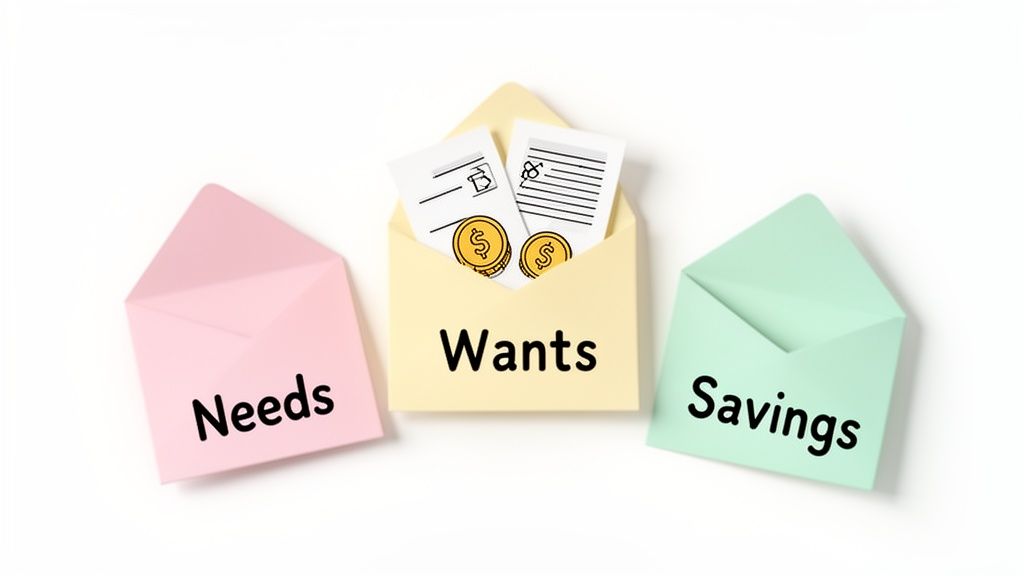
The system works by making your spending choices visible and finite:
- Physical Envelopes: Use real cash for categories prone to overspending. The act of handing over physical money creates a psychological barrier, promoting more mindful consumption.
- Digital Envelopes: Modern apps like Goodbudget or features within some banking apps allow you to create virtual "envelopes" or sub-accounts. This provides the same compartmentalization without the need to carry cash.
Why This Framework Works for Families
The tactile nature of the envelope system is exceptionally effective for teaching financial concepts and for individuals rebuilding financial confidence. It transforms abstract budget numbers into concrete, manageable portions, which is invaluable for visual learners and those new to managing money.
For instance, a grandparent can use this to teach financial literacy by giving each grandchild an allowance split into three small envelopes: "Spend," "Save," and "Give." This simple exercise instills the core principles of allocation and delayed gratification from a young age. Similarly, a family steward managing an aging parent's finances can use separate envelopes or accounts for "Care Costs," "Medications," and "Personal Items," ensuring complete transparency and accountability with siblings.
How to Implement the Envelope System
- Identify Problem Categories: Review your spending and pinpoint areas where you consistently go over budget, such as dining out, personal care, or hobbies. These are the best candidates for envelopes.
- Fund Your Envelopes: At the start of your pay period, withdraw the budgeted cash amount and fill each physical envelope. For digital users, transfer the allocated funds into your designated sub-accounts or app categories.
- Spend Only From the Envelope: When you go grocery shopping, use only the cash from the "Groceries" envelope. If the money runs out, you must wait until the next month to replenish it, forcing creative solutions like cooking from the pantry.
- Schedule Weekly Check-ins: Hold a brief family meeting to review the envelopes. This keeps everyone accountable and aware of the remaining funds, turning budgeting into a collaborative effort.
4. Automated Savings & Pay-Yourself-First Strategy
The "pay yourself first" principle is a cornerstone of disciplined wealth-building, and automation is the engine that makes it effortless. This strategy fundamentally reverses the typical budgeting flow: instead of saving what's left after spending, you automatically transfer a set portion of your income into savings and investment accounts the moment you get paid. It's one of the most powerful budgeting tips for families because it removes willpower and decision fatigue from the equation, ensuring your future is prioritized.
This method treats your savings contributions as a non-negotiable bill you pay to your future self.
- Prioritizes Savings: By setting money aside before you can spend it on discretionary items, you guarantee progress toward your financial goals.
- Removes Temptation: The money is moved out of your primary checking account, making it less visible and less likely to be spent impulsively.
- Builds Consistency: Automation creates a powerful habit of regular saving, which is the key to harnessing the power of compound interest over time.
Why This Strategy Works for Families
For family stewards managing multiple financial goals, automation is a game-changer. It allows you to systematically fund different objectives without constant oversight. A caregiver can set up separate, automatic transfers for an elderly parent's medical fund, their own retirement account, and a 529 plan for a grandchild, ensuring all generational needs are met consistently.
This approach is also incredibly empowering for women rebuilding financial independence. For instance, a widow receiving pension income can set up an automatic 20% transfer to an investment account. This simple, recurring action rebuilds her asset base and, just as importantly, her confidence in managing her financial future.
How to Implement the Pay-Yourself-First Strategy
- Determine Your Percentage: Start by automating 10% of your after-tax income. The key is to begin immediately, even with a small amount. Aim to increase this by 1% each year until you reach your target savings rate.
- Time Your Transfers: Schedule your automatic transfers to occur one or two days after your payday. This ensures the funds are available but moves the money before other bills are paid or spending begins.
- Create Goal-Specific Accounts: Open separate high-yield savings accounts for each major goal (e.g., "Emergency Fund," "New Car," "Vacation"). This creates clarity and reduces the temptation to pull funds from one goal for another.
- Automate Investments: Don't just save; automate your investments to combat inflation. Set up recurring transfers from your checking account directly into a brokerage account, IRA, or 401(k).
5. The Sinking Fund Method (Dedicated Funds for Irregular Expenses)
One of the most powerful budgeting tips for families is the sinking fund method, a proactive strategy for managing large, predictable expenses that don't occur monthly. This technique prevents the financial shock of annual insurance premiums, property taxes, or holiday spending by breaking down these big costs into smaller, manageable monthly savings goals. It transforms surprise budget-busters into planned, stress-free events.
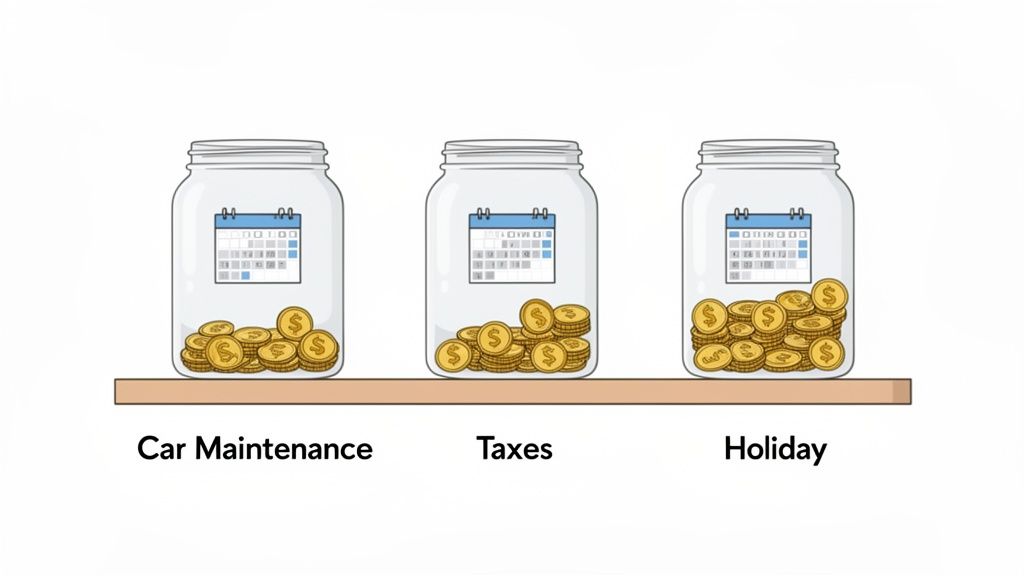
This method involves creating dedicated savings accounts for specific, irregular expenses. By setting aside a small amount each month, you ensure the full amount is ready when the bill is due. Key expenses families often use sinking funds for include:
- Annual & Semi-Annual Bills: Property taxes, car registration, and insurance premiums.
- Maintenance & Repairs: Anticipated home upkeep, car maintenance, or appliance replacement.
- Seasonal & Personal Events: Holiday gifts, back-to-school shopping, and family vacations.
- Medical Costs: Saving for deductibles or known upcoming procedures.
Why This Framework Works for Families
The sinking fund method is particularly valuable for family stewards managing multiple household budgets. It brings predictability to the complex finances of an aging parent, ensuring funds are available for their annual property taxes or insurance without creating a last-minute crisis. It allows for intentional financial planning that respects everyone's needs.
For instance, a single parent can create separate sinking funds for back-to-school supplies, kids' activity fees, and holiday gifts. This prevents the need to dip into emergency savings or accrue credit card debt when these large, seasonal expenses arrive. The method provides peace of mind and financial stability, demonstrating the power of planning.
How to Implement the Sinking Fund Method
- Identify Your Expenses: List all predictable expenses that you pay less than monthly. Look back at the last year to identify costs like car repairs, vet bills, or annual subscriptions.
- Calculate Monthly Contributions: For each expense, take the total estimated annual cost and divide it by 12. This is the amount you need to save each month for that specific fund.
- Segregate the Funds: Open separate, high-yield savings accounts or use a banking app that allows for digital "envelopes" or sub-accounts. Label each one clearly (e.g., "Property Tax Fund," "Holiday 2024").
- Automate and Celebrate: Set up automatic monthly transfers from your main checking account into each sinking fund. When a fund successfully covers a large expense, acknowledge it with the family to reinforce the value of proactive saving.
6. Family Money Meetings & Transparent Communication
Beyond spreadsheets and apps, one of the most powerful budgeting tips for families is creating a culture of financial transparency through regular family money meetings. These scheduled conversations provide a safe and structured forum to discuss goals, review spending, and align on financial priorities. This proactive communication demystifies money, reduces conflict, and ensures everyone, from young children to aging parents, feels heard and understood.
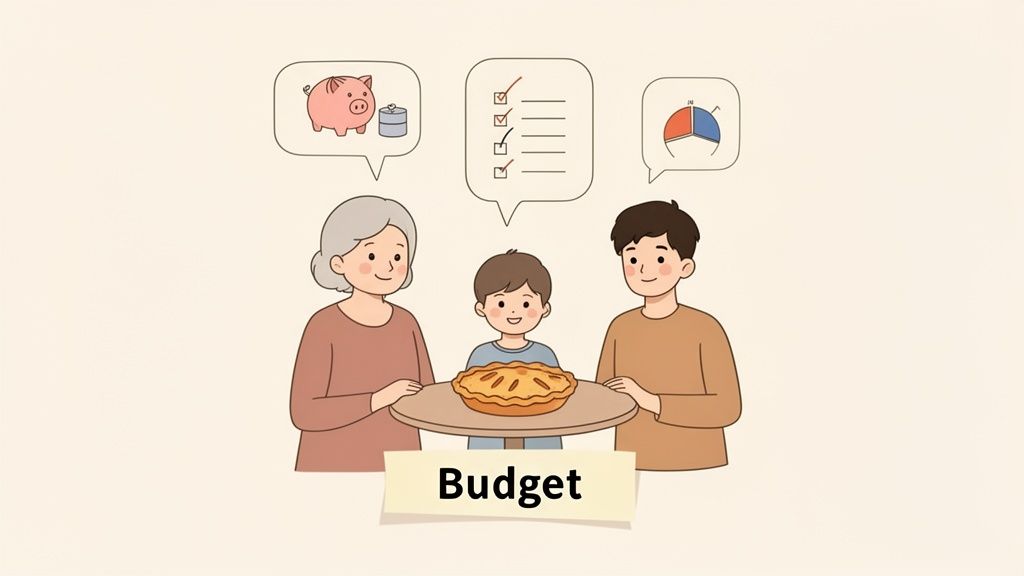
The core purpose of these meetings is to transform money from a taboo topic into a tool for achieving shared family dreams.
- For Young Families: It's a space to align on big goals like saving for a house or paying for college.
- For Multigenerational Households: It ensures transparency in managing eldercare costs and coordinating resources across generations.
- For Grandparents: It’s an opportunity to discuss legacy, inheritance philosophy, and transfer financial values.
Why This Framework Works for Families
Family money meetings are particularly effective for family stewards coordinating care for aging parents. When siblings meet monthly to review their parents' budget and care costs, it prevents misunderstandings and ensures everyone is on the same page. Transparency builds trust and collaborative decision-making during what can be a stressful time.
For a couple with teenagers, a bi-weekly meeting can be a forum to review the family budget, discuss an upcoming large purchase like a car, and ask for the teens' input on vacation priorities. This involvement gives them a sense of ownership and practical financial education. You can learn more about teaching children financial responsibility on smartfinanciallifestyle.com.
How to Implement Family Money Meetings
- Schedule and Structure: Make the meeting a recurring, non-negotiable event (e.g., the first Sunday of every month). Create a simple agenda covering wins, budget review, goal progress, and upcoming expenses.
- Start with Positivity: Begin each meeting by sharing a recent financial "win," no matter how small. This sets a positive, collaborative tone and reduces financial anxiety.
- Use Visuals: A simple chart showing progress toward a savings goal or a pie chart of the monthly budget can make abstract numbers tangible and easier for everyone to understand.
- Practice Empathy: Encourage the use of "I" statements, such as "I feel anxious when our credit card balance is high." This focuses on feelings and shared problem-solving rather than blame.
7. Expense Tracking & Spending Awareness (The Foundation)
Before any budget can succeed, you must first understand where your money is actually going. Expense tracking is the foundational diagnostic tool that provides this clarity. It involves meticulously recording every dollar spent over a set period, typically 30 to 90 days, to create an honest, data-driven picture of your family’s financial habits. This isn't about judgment; it's about gaining awareness to make informed decisions.
The process is simple but powerful:
- Observe Don't Change: For the tracking period, continue spending as you normally would. The goal is to capture your authentic behavior, not an idealized version.
- Record Everything: Document every expense, from the mortgage payment down to the morning coffee or vending machine snack. Small purchases often reveal the most surprising patterns.
- Categorize Consistently: Group spending into logical categories like "Groceries," "Utilities," "Dining Out," and "Subscriptions." This helps you identify where money "leaks."
Why This Practice Works for Families
For families navigating complex financial situations, such as managing a multigenerational household or rebuilding after a divorce, awareness is the first step toward control. It replaces assumptions with facts, empowering family members to tackle financial challenges collaboratively and with confidence. This is one of the most essential budgeting tips for families because it builds the bedrock for all other financial strategies.
A recently divorced woman, for instance, can track her expenses for 60 days to truly understand the cost of living independently. This exercise not only helps her create a realistic budget but also rebuilds her financial confidence by giving her concrete data to work with, turning uncertainty into a clear action plan.
How to Implement Expense Tracking
- Choose Your Tool: Use an app like YNAB or Mint for automated tracking, or opt for a simple spreadsheet or notebook. The tactile nature of manually writing down expenses can often heighten awareness.
- Use Your Statements: At the end of each week, cross-reference your records with bank and credit card statements to catch anything you may have missed. This ensures accuracy.
- Hold a Weekly Review: Sit down as a family for 15 minutes each week to review the numbers. Discussing spending patterns together creates shared accountability and prevents the task from becoming overwhelming at the end of the month.
- Identify the "Leaks": After the tracking period, look for the top three to four categories where spending was higher than you expected. Celebrate this discovery; it’s not a failure, but an opportunity to redirect those funds toward your goals.
8. The 'Needs vs. Wants' Framework with Family Values Alignment
A foundational principle of personal finance, the ‘needs versus wants’ framework, becomes a profound tool for family budgeting when aligned with core values. This method moves beyond simple categorization by prompting families to define what is truly essential for their unique security, happiness, and legacy. It's one of the most powerful budgeting tips for families because it transforms spending from a transactional act into a reflection of your shared priorities.
The framework requires you to classify every expense into two simple but meaningful categories:
- Needs: These are the non-negotiable expenses for survival, security, and well-being. This includes essentials like housing, food, and healthcare, but also expands to include items your family defines as critical based on its values.
- Wants: This category includes everything else-items and experiences that enhance life but are not essential for your fundamental security. These are often the first expenses to be adjusted when budgets are tight.
Why This Framework Works for Families
This approach is especially powerful for multigenerational households because it forces open, honest conversations about what matters most. It allows a family to collaboratively define its financial mission, ensuring that resources are directed toward goals that everyone supports, from eldercare to education.
For example, a recently retired couple might decide that travel is a ‘need’ for maintaining connection with grandchildren and ensuring quality of life in their golden years. By classifying it as a need, they prioritize it in their budget, consciously creating boundaries around other discretionary ‘wants.’ This values-based decision provides clarity and prevents guilt, aligning their spending with their life’s purpose.
How to Implement the Needs vs. Wants Framework
- Hold a Family Values Meeting: Before categorizing expenses, discuss and write down what your family values most. Is it security, education, community, health, or shared experiences? This list becomes your compass.
- Define Your Needs Collaboratively: Create a shared list of family ‘needs.’ Acknowledge that this can include non-traditional items. A career-building course for one parent might be a ‘need’ for future family earning potential, while therapy could be a ‘need’ for emotional stability.
- Categorize Every Expense: Go through your last month’s spending and assign each item to either the "Needs" or "Wants" column. Be honest. This exercise provides a clear snapshot of where your money is currently flowing.
- Align Spending with Values: Review your categorized list. Is your spending pattern aligned with your family’s stated values? If not, identify which ‘wants’ can be reduced to free up funds for the ‘needs’ and high-priority goals you’ve defined together.
9. The Emergency Fund Strategy (Foundation for Financial Security)
One of the most crucial budgeting tips for families is establishing a dedicated emergency fund. This isn't just another savings account; it's a financial safety net designed to absorb life's unexpected shocks, from a sudden job loss to an urgent home repair. This fund, typically holding three to six months of essential living expenses, is the bedrock of financial security, preventing you from derailing your long-term goals or accumulating debt when a crisis hits.
The core principle is simple:
- Purpose: To cover non-discretionary expenses during an unforeseen event.
- Amount: Traditionally 3-6 months of essential living costs (mortgage/rent, utilities, groceries, insurance).
- Location: A separate, liquid account like a high-yield savings account, making it accessible but not too easy to spend on impulse buys.
Why This Strategy Works for Families
An emergency fund provides peace of mind, a priceless asset during stressful life transitions. It acts as a buffer that allows for clear-headed decision-making when emotions are running high. This strategy is non-negotiable for anyone seeking true financial independence.
For instance, a recently divorced woman rebuilding her career can prioritize creating a six-month emergency fund. This gives her the stability and confidence to pursue new opportunities without the constant fear of a single unexpected expense collapsing her progress. Similarly, family stewards managing elder care might maintain a larger fund (6-12 months) to account for unpredictable medical costs for multiple generations under their care.
How to Implement the Emergency Fund Strategy
- Start with a 'Baby' Fund: Don't be intimidated by the 3-6 month goal. Begin by saving a more achievable $1,000. This initial fund can cover smaller emergencies like a car repair and builds momentum.
- Define Your 'Emergency': Sit down as a family and explicitly agree on what constitutes a true emergency. Job loss, critical medical needs, and essential home repairs qualify; a last-minute vacation does not.
- Automate and Separate: Open a high-yield savings account and label it "EMERGENCY FUND - DO NOT TOUCH." Set up automatic, recurring transfers from your checking account after every payday. Making it slightly inconvenient (no debit card attached) prevents impulse withdrawals. For a complete guide, review our Emergency Fund Checklist for True Financial Resilience on smartfinanciallifestyle.com.
- Replenish Immediately: If you use the fund, your top financial priority becomes rebuilding it. Pause other savings goals temporarily and aggressively redirect funds to restore your safety net.
10. Strategic Debt Payoff Planning (High-Interest First vs. Psychological Wins)
A methodical approach to eliminating debt is one of the most empowering budgeting tips for families, as it directly frees up cash flow and reduces financial stress. The key is choosing a strategy that aligns with your family's financial situation and emotional needs, typically boiling down to two popular methods: the Debt Snowball and the Debt Avalanche.
These proven strategies provide a clear roadmap for tackling outstanding balances:
- The Debt Avalanche (Mathematical Efficiency): You prioritize paying off the debt with the highest interest rate first, while making minimum payments on all other debts. This method saves the most money over time because you are aggressively targeting the most expensive debt.
- The Debt Snowball (Psychological Momentum): Popularized by Dave Ramsey, this method involves paying off the smallest debt first, regardless of the interest rate. The quick wins from eliminating entire accounts build confidence and motivation to keep going.
Why This Framework Works for Families
Choosing a debt payoff strategy is a deeply personal decision that can provide control during life transitions. A divorced woman rebuilding her finances might choose the Debt Avalanche to aggressively attack high-interest credit card debt, stopping the financial bleeding and accelerating her path to independence.
Conversely, a recently widowed individual managing multiple small medical bills, a car loan, and a credit card may find the Debt Snowball more effective. By paying off the smallest bills first, they gain a sense of accomplishment and momentum. This psychological boost is often crucial for maintaining the long-term discipline required to become debt-free.
How to Implement a Debt Payoff Strategy
- List All Debts: Create a spreadsheet listing every debt with its total balance, interest rate, and minimum monthly payment. This clarity is the foundation of your plan.
- Choose Your Method: Decide as a family whether the mathematical savings of the Avalanche or the motivational wins of the Snowball is the right fit. There is no wrong answer.
- Attack and Automate: Once you've paid off your first targeted debt, roll that entire payment amount into the next debt on your list. This "snowball" or "avalanche" effect accelerates your progress.
- Avoid New Debt: The plan only works if you stop adding to the problem. Commit to pausing all new credit card spending or loans until your existing consumer debt is eliminated. For some situations, it may be helpful to understand how to negotiate credit card debt on smartfinanciallifestyle.com to lower balances or rates.
Family Budgeting: 10-Strategy Comparison
| Method | Implementation Complexity 🔄 | Resource Requirements ⚡ | Expected Outcomes 📊 | Ideal Use Cases 💡 | Key Advantage ⭐ |
|---|---|---|---|---|---|
| The 50/30/20 Budget Framework | Low — simple percentage rules | Low — basic banking/tools | Balanced spending, steady savings growth | Beginners, families, multigenerational teaching | Easy-to-follow structure; scalable across households (⭐⭐⭐) |
| Zero-Based Budgeting (Every Dollar Has a Job) | High — monthly, line-by-line planning | Medium — time + budgeting tools/apps | Highly intentional spending; reduced invisible spend | Complex households, variable income, rebuilding finances | Maximizes alignment of spending with values (⭐⭐⭐⭐) |
| The Envelope System (Digital or Physical) | Low–Medium — set up envelopes or sub-accounts | Low — cash/envelopes or digital app | Strong category control; prevents overspending in problem areas | Teaching kids, behavioral spenders, cash-preferred users | Powerful psychological barrier to overspending (⭐⭐⭐) |
| Automated Savings & Pay-Yourself-First | Low — set-and-forget automations | Low — accounts and transfer rules | Consistent savings, compound growth, less decision fatigue | Busy households, legacy builders, those rebuilding security | Removes willpower; ensures steady progress (⭐⭐⭐⭐) |
| The Sinking Fund Method | Medium — identify and maintain multiple funds | Medium — sub-accounts and monthly allocations | Predictable handling of irregular costs; fewer surprises | Families with irregular annual expenses, eldercare, retirees | Smooths cashflow for predictable irregular expenses (⭐⭐⭐⭐) |
| Family Money Meetings & Transparent Communication | Medium — regular facilitation and agenda | Low — time and willingness to share | Better alignment, reduced conflict, shared values | Multigenerational households, family stewards, estate planning | Builds transparency and transfers financial values (⭐⭐⭐⭐) |
| Expense Tracking & Spending Awareness (The Foundation) | Medium — daily/weekly logging for 30–90 days | Low–Medium — apps or spreadsheet + time | Accurate baseline; reveals leaks and easy cutbacks | Everyone starting budgeting or rebuilding after disruption | Diagnostic foundation for all budgeting decisions (⭐⭐⭐⭐) |
| The 'Needs vs. Wants' Framework with Family Values | Low — simple categorization + discussion | Low — time to define values | Clearer priorities; less guilt about intentional spending | Families clarifying priorities, value-driven budgets | Values-aligned spending decisions (⭐⭐⭐) |
| The Emergency Fund Strategy | Low — straightforward but time-consuming to build | Medium — liquid savings set aside | Reduced crisis debt; immediate financial resilience | Single-income households, those rebuilding, retirees | Core safety net preventing high-interest debt (⭐⭐⭐⭐) |
| Strategic Debt Payoff Planning (Snowball vs Avalanche) | Medium — structured timeline and discipline | Medium — extra payments and planning | Reduced interest costs (avalanche) or faster momentum (snowball) | Households with consumer debt, pre-retirement planners | Clear path to debt freedom; frees cash for other goals (⭐⭐⭐⭐) |
Your Family's Next Smart Financial Decision
As we've journeyed through these ten powerful budgeting strategies, one truth becomes clear: managing your family’s finances is less about rigid spreadsheets and more about creating a shared language of value, intention, and security. From the foundational structure of the 50/30/20 rule to the granular control offered by Zero-Based Budgeting, each method is a tool designed to be shaped to your family’s unique blueprint. You are not just balancing a checkbook; you are building a legacy.
These budgeting tips for families are not meant to be adopted all at once. The goal is progress, not perfection. Whether you are a young couple starting out, a single parent navigating solo, or grandparents looking to pass on wisdom, the most crucial step is the one you take next. The power lies in moving from abstract worry to concrete action.
From Knowledge to Action: Your Next Steps
The true value of this guide is realized when you transform these concepts into tangible habits. Over my 50+ years in finance, I've seen that the families who succeed are not necessarily the ones with the highest income, but the ones with the clearest communication and the most consistent habits.
Here is your immediate action plan:
- Choose Your Starting Point: Don't get overwhelmed. Select just one strategy from this list that feels most achievable right now. Is it the tangible control of the Envelope System? Or perhaps the set-it-and-forget-it power of Automated Savings?
- Schedule a Family Money Meeting: Put it on the calendar. This isn't a lecture; it's a conversation. Discuss the chosen strategy and collectively define what financial security looks like for your household. Aligning on your 'why' makes the 'how' infinitely easier.
- Implement and Iterate: Start small. Track your expenses for one week. Set up one sinking fund for the holidays. Automate a single transfer to savings. The key is to build momentum. Review your progress in a month and adjust as needed. Your budget is a living document, not a stone tablet.
A Key Takeaway: Your budget is the ultimate expression of your family's values. It's the practical tool that translates your hopes for education, security, and shared experiences into a day-to-day reality.
The Lasting Impact of Financial Clarity
Mastering these budgeting frameworks does more than just organize your money. It reduces financial stress, a common source of friction in any household. It empowers every family member with a sense of ownership and responsibility. It provides the stability needed to weather life's inevitable storms, turning potential crises into manageable inconveniences.
Ultimately, these budgeting tips for families are about creating freedom. It’s the freedom to make choices based on your goals, not your limitations. It’s the freedom that comes from knowing you have a plan for the future, a safety net for the present, and a clear path to leaving a meaningful legacy for the generations that follow. You have the tools. Now is the time to build.
Ready to transform these tips into a sustainable financial plan? The journey to financial clarity is simpler with a dedicated guide. At Smart Financial Lifestyle, we provide personalized coaching and resources that help families like yours implement these strategies effectively. Visit Smart Financial Lifestyle to discover how we can help you build a confident and secure financial future, together.