
What Is Estate Tax Exemption A Guide to Protecting Your Legacy

The estate tax exemption is a term you hear a lot in financial planning, but what does it actually mean? Put simply, it’s the total value of assets you can leave to your heirs without triggering the federal estate tax.
Think of it as a massive, government-issued “tax-free” pass for your legacy. Only the portion of your estate that goes above this generous limit is even looked at for potential taxes.
Decoding the Estate Tax Exemption
Let’s use an analogy. Imagine your entire estate is a bucket of water. The estate tax exemption is a line drawn way up near the top of that bucket. As long as the water level—the value of your assets—stays below that line, no tax is due. If your assets fill the bucket and spill over, only the overflow gets taxed.
This concept is the bedrock of modern estate planning.
For the vast majority of American families, this high threshold means the federal estate tax is a complete non-issue. The government deliberately set the exemption this high to target only the wealthiest estates, letting most people pass on their life's work without worrying about a federal tax bill. Getting a handle on this is your first step toward a smarter financial plan for your family’s future.
Key Components of the Exemption
To really understand the estate tax exemption, it helps to break it down into its moving parts. These elements work together to define how and when the tax might apply.
- Lifetime Exemption: This is a unified credit that covers both gifts you make during your life and the assets you pass on after your death.
- Portability: This is a game-changer for married couples. Portability lets a surviving spouse use any of their deceased spouse's leftover exemption. It effectively doubles the amount a couple can shield from taxes.
- Inflation Adjustments: The exemption amount isn't set in stone. It’s tied to inflation, which means it usually ticks up a little bit each year to keep pace with the economy.
These features give you and your family a flexible framework to plan your legacy. With the right strategies, like smart gifting or using specific accounts, you can make sure your assets are protected and go exactly where you want them to. For those looking to shield assets from the taxable estate, understanding what a trust fund is and how it works is an incredibly valuable next step.
At its core, the estate tax exemption isn’t just a number—it’s a powerful tool that empowers you to direct your wealth and secure your family’s financial future with confidence and clarity.
To make this even clearer, I've put together a simple table that breaks down the key ideas at a glance. It’s a quick snapshot of how the federal exemption really operates.
Federal Estate Tax Exemption at a Glance
| Concept | Details | What It Means for You |
|---|---|---|
| Exemption Threshold | The total value of assets you can transfer tax-free. | If your estate's value is below this amount, no federal estate tax is owed. |
| Taxable Estate | The portion of an estate's value above the exemption amount. | Only this "overflow" value is subject to the federal estate tax, currently at a 40% rate. |
| Unified Credit | The exemption applies to both lifetime gifts and bequests at death. | Large gifts made during your life can reduce the exemption available for your estate later. |
Think of this table as your cheat sheet. These are the foundational concepts you'll need to know as you start thinking more seriously about your own estate plan.
Understanding the Evolution of Estate Tax Rules
To really get a handle on the current estate tax exemption, it helps to know that these rules are anything but set in stone. Tax laws are always shifting, bending to political winds and economic needs, and the estate tax has gone through some of the most dramatic changes we’ve seen in the last decade. These shifts directly impact how families like yours plan for the future.
The biggest recent shake-up came from a major piece of legislation that completely redrew the map for estate planning. This law didn’t just nudge the numbers a bit; it fundamentally changed the conversation for countless families.
This timeline shows how legacy planning is the final, crucial step in a lifelong financial journey.
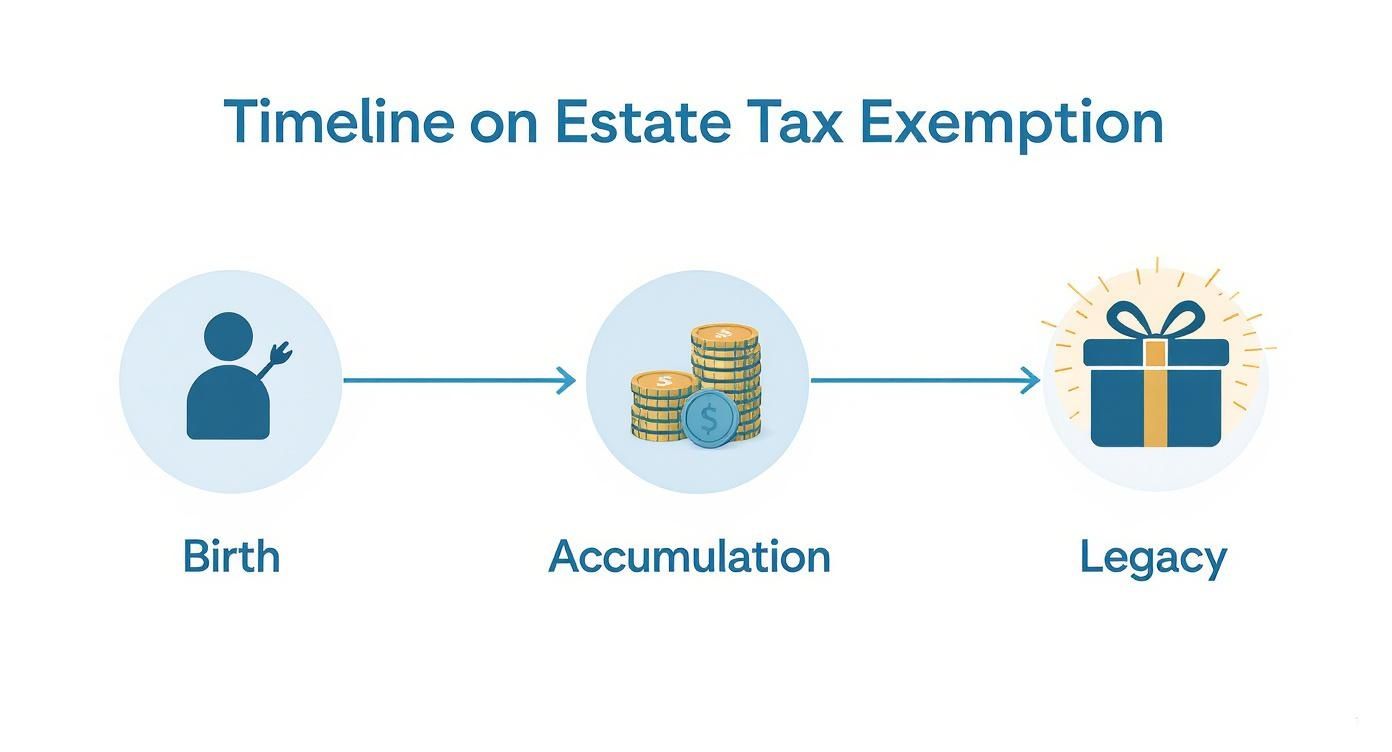
As you can see, planning for how your assets are passed on is the capstone of a lifetime of hard work and careful financial stewardship.
The Impact of the Tax Cuts and Jobs Act
The Tax Cuts and Jobs Act (TCJA), passed in 2017, was an absolute game-changer for estate planning. Before the TCJA, the federal exemption was already pretty generous, but this act essentially doubled it overnight. That move immediately took a huge number of estates off the federal tax radar.
Specifically, the TCJA boosted the base exemption from $5 million to $10 million per person, with adjustments for inflation each year. This meant that by 2025, a single person could pass on nearly $14 million tax-free, and a married couple could shield almost $28 million. It was an unprecedented level of protection.
But this incredible generosity came with a major catch—one that created a decade of uncertainty for families and their advisors.
The real challenge with the TCJA wasn't just the high exemption amount, but the fact that it was temporary. This created a 'use it or lose it' mindset for many high-net-worth families.
This ticking clock was known as the "sunset provision."
The Sunset Provision and Planning Uncertainty
The high exemption levels from the TCJA were never meant to be permanent. The law was written with a sunset provision, scheduling the exemption to automatically snap back to its pre-TCJA levels at the end of 2025. This meant the exemption would get chopped roughly in half, falling from almost $14 million back down to an inflation-adjusted number around $7 million.
This looming deadline created a huge planning dilemma. Families with estates valued somewhere between the old and new exemption amounts faced a critical choice:
- Act Now: Take advantage of the high exemption by making significant lifetime gifts before it vanishes.
- Wait and See: Hope that new laws might make the higher amounts permanent, but risk losing the opportunity entirely.
This uncertainty kicked off a massive wave of proactive estate planning. Many people accelerated their gifting strategies, using trusts and other tools to lock in the high exemption while they could. It’s a situation that underscores a key lesson from Paul Mauro's 50+ years of experience: tax laws are always in motion, and waiting to act can be a very expensive mistake.
The estate tax exemption in the United States saw massive shifts because of the TCJA, which doubled the federal lifetime exemption. This led to an exemption of $13.99 million per person for 2025, but the scheduled sunset at the end of the year meant it was set to revert to about $7 million. You can explore more on these legislative shifts in this detailed 2024 estate planning overview from KPMG.
Ultimately, the TCJA saga is a powerful reminder that estate planning isn't a "set it and forget it" task. It’s an ongoing process that has to adapt to a legal environment that is constantly changing.
The Current Federal Estate Tax Exemption Explained
For years, the estate planning world felt like it was on shaky ground. We were all dealing with the temporary measures from the TCJA, holding our breath and wondering when the other shoe would drop. That uncertainty is finally over. A new legislative chapter has begun, giving families and their advisors the long-term clarity we’ve needed to make smart financial decisions without a ticking clock in the background.
The old "sunset provision" was a massive headache. It forced everyone to plan around a worst-case scenario where the high exemption levels could vanish overnight. Thankfully, that's no longer the case. We now have a clear, permanent baseline, which allows for much more strategic and less frantic legacy planning.
A New Era of Certainty in Estate Planning
Let’s get right to it. The One Big Beautiful Bill Act (OBBBA), signed into law on July 4, 2025, marks a huge shift in U.S. estate tax policy. It permanently sets the federal unified estate and gift tax exclusion at $15 million per person, effective January 1, 2026.
This is a big deal. It completely gets rid of the looming sunset provision that would have slashed the exemption in half. Even better, under the OBBBA, this $15 million baseline will be indexed for inflation starting in 2027, so its value won’t get eaten away over time. You can read up on the specifics of this landmark legislation from Goodwin Law.
What this really means is that we finally have a reliable floor for estate planning. No more guessing games.
Key Features of the Current Exemption
The new law is more than just a number; it keeps some critical features that give your estate plan real power and flexibility. Getting a handle on these components is the key to protecting your family’s legacy.
- Individual Exemption: Every person gets a $15 million federal exemption. This is the amount you can pass on—either through gifts during your lifetime or after your death—without triggering federal estate tax.
- Married Couple Exemption: This is where it gets powerful for couples. Together, you can shield a combined $30 million from estate taxes. It’s an incredible tool for protecting a substantial amount of wealth for your children and grandchildren.
- Inflation Adjustment: Beginning in 2027, the $15 million base will get an annual cost-of-living adjustment. This is huge because it ensures the exemption's real-world value keeps up with the economy.
These features all work in concert to create a seriously robust shield against federal estate taxes.
"The establishment of a permanent, high exemption amount brings welcome stability. It allows families to plan with confidence, knowing the rules of the game won't suddenly change."
This is the kind of long-term thinking Paul Mauro has been championing for over 50 years. Strategic planning is always better than making reactive decisions driven by anxiety over tax laws.
What Has Not Changed
Just as important as what's new is what has stayed the same. The good news is that the OBBBA kept several of the most effective planning tools that have been the cornerstones of smart estate strategies for decades.
This continuity means the proven strategies we've relied on for years are still just as relevant and effective. Here are the key elements that are still in place:
- Portability: This is a big one for married couples. The ability for a surviving spouse to use any unused portion of their deceased spouse's exemption is still in effect. It’s the mechanism that allows couples to fully use their combined $30 million exemption.
- Annual Gift Tax Exclusion: You can still give a certain amount of money to as many people as you want each year without touching your $15 million lifetime exemption. It remains a simple but powerful way to reduce your taxable estate over time.
- Generation-Skipping Transfer (GST) Tax Exemption: The GST tax exemption is still aligned with the estate tax exemption, set at $15 million. This lets you transfer wealth directly to your grandchildren or even later generations without getting hit by the separate—and very steep—GST tax.
By understanding both the new permanent exemption and the familiar tools that were preserved, you're in a great position to build a resilient and effective plan to secure your family's future.
Navigating Federal vs. State Estate Taxes
Focusing only on the federal estate tax exemption is one of the most common—and costly—mistakes I see in financial planning. While the high federal limit gives many families a huge sigh of relief, it’s only half the story.
A dozen states, plus the District of Columbia, have decided to play by their own rules. They impose their own separate estate or even inheritance taxes.
This creates a tricky two-tiered system. Your legacy could be completely safe from Uncle Sam but still face a substantial tax bill from your state government. The thresholds at the state level are often dramatically lower, catching families by surprise who thought they were well clear of any tax liability.
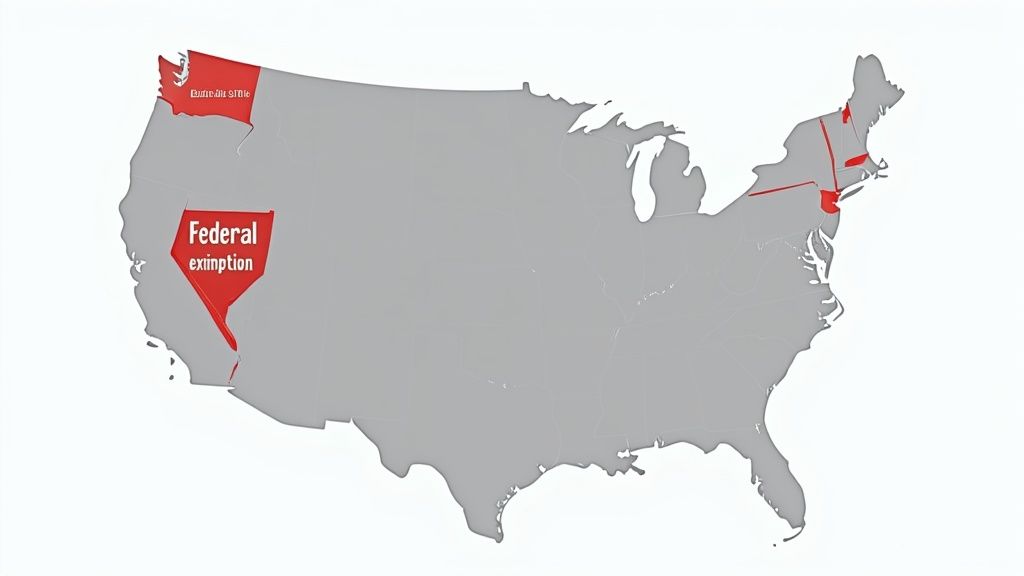
Understanding this distinction isn't just a minor detail. It's a critical part of building a resilient estate plan that protects your assets from every angle. Your state of residence dictates an entirely different set of rules you absolutely must plan for.
The State-Level Tax Surprise
Let’s walk through a quick example. Imagine your estate is valued at $8 million.
From a federal perspective, you’re comfortably below the current exemption, meaning you owe zero federal estate tax. Great news, right? But if you live in a state with its own estate tax, the picture changes completely.
Many states have exemption amounts that are far less generous. While the U.S. federal exemption for 2025 is a lofty $13.99 million per person, a state like New York sets its exemption at $7.16 million—and it doesn't allow for portability between spouses. This stark difference means an $8 million estate in New York could owe state taxes even though it’s far below the federal threshold.
This scenario is exactly why a one-size-fits-all approach to estate planning is bound to fail. Your strategy has to be tailored to the laws of the state where you live.
The most significant blind spot in many estate plans is the failure to account for state-specific taxes. An otherwise perfect plan can unravel if it ignores the rules of your home state.
Let’s break down the key differences to make this crystal clear.
Federal vs. State Estate Tax Exemption: A Comparison
The gap between federal and state systems goes well beyond just the exemption amounts. They often have different rules for tax rates, deductions, and one of the most important tools for married couples: portability.
The table below illustrates just how different these two systems can be, using New York as a common example.
| Feature | Federal Estate Tax | Example State Estate Tax (e.g., New York) |
|---|---|---|
| Exemption Amount | $13.99 million per individual (for 2025). | $7.16 million per individual (not indexed). |
| Portability | Yes. A surviving spouse can use any unused exemption. | No. The unused exemption of the first spouse to die is lost. |
| Tax Rate | A flat 40% on the amount over the exemption. | Progressive rates, often ranging from 5% to 16%. |
| Planning Focus | Primarily for very high-net-worth individuals. | Affects a much broader range of estates. |
As you can see, the state and federal systems can feel like they operate in parallel universes. A strategy designed only for the federal rules, like relying on portability, could leave a surviving spouse unexpectedly exposed to a significant state tax bill. It’s a planning disaster waiting to happen.
Inheritance Tax: A Different Beast Altogether
Just to add another layer of complexity, some states don't have an estate tax but instead impose an inheritance tax. What’s the difference?
- An estate tax is paid by the estate before any assets are distributed to heirs.
- An inheritance tax is paid by the heirs after they receive their inheritance.
States like Pennsylvania levy an inheritance tax, where the rate depends on the heir's relationship to the person who passed away. Spouses are often exempt, but children, siblings, and other relatives pay different rates. You can see how this works in practice by exploring our detailed guide on how inheritance tax in PA is calculated.
Ultimately, your location on the map has a profound impact on your estate plan. A strategy that works perfectly in a state with no estate tax, like Florida or Texas, would be completely inadequate in a state like Washington or New York. This is where personalized, expert advice becomes absolutely essential.
Practical Strategies to Maximize Your Exemption
Alright, knowing what the estate tax exemption is is one thing. But actually using that knowledge to protect your legacy? That’s where the real work begins. Moving from theory to practice means using smart, legal strategies to shrink your taxable estate so more of your wealth ends up with your loved ones, not the government. These aren’t sketchy loopholes; they’re established financial planning tools.
The goal here is to thoughtfully move assets over time, making the most of every exemption and exclusion you have. Think of your estate like a large reservoir. The idea is to carefully divert water into smaller, designated channels—your heirs—long before the reservoir overflows and the taxman shows up.
Let's walk through some of the most effective ways to do this.

Embrace Strategic Lifetime Gifting
One of the simplest and most powerful tools in the playbook is the annual gift tax exclusion. This rule is a gem. It lets you give a certain amount of money every year to as many people as you want without ever touching your lifetime estate tax exemption. For 2025, that amount is $19,000 per person.
A married couple can double down on this, combining their exclusions to give $38,000 to each person, every year, completely tax-free. Do that for a few years, and you can significantly lower your taxable estate while giving your family a helping hand right now.
For example, a couple with three kids could hand over $114,000 every single year without filing a gift tax return or reducing their lifetime exemption. It's a fantastic way to see your legacy in action while you're still around. To get deeper into the rules, check out our guide on gifting money to family members.
Use Irrevocable Trusts to Your Advantage
If you have assets that are poised to grow—think stocks, real estate, or a business—irrevocable trusts are a cornerstone of savvy estate planning. When you move assets into an irrevocable trust, you're legally taking them out of your name. That means they're no longer part of your future taxable estate. Even better, any appreciation on those assets also happens outside your estate, shielding that growth from taxes down the line.
There are a few different types of trusts, each with a specific job:
- Spousal Lifetime Access Trust (SLAT): This lets one spouse gift assets into a trust that benefits the other spouse. It gets the money out of your combined estates, but your family can still indirectly access the funds if needed.
- Irrevocable Life Insurance Trust (ILIT): This trust is set up specifically to own a life insurance policy. By doing this, the death benefit pays out to the trust—not your estate—providing tax-free cash for your heirs to cover taxes or other expenses.
These are not DIY tools; you'll need a good attorney to set them up properly. But for protecting wealth across generations, they're incredibly effective.
“Moving assets out of your estate early is like planting a tree in your child’s yard instead of your own. You get the satisfaction of providing for them, and all the future growth belongs to them, completely separate from your own property.”
That proactive mindset is exactly what you need to make the most of your exemption.
Secure the Portability Election
For married couples, portability is a concept you absolutely cannot ignore. It allows a surviving spouse to use any leftover portion of their deceased spouse's estate tax exemption. The official term is the Deceased Spousal Unused Exclusion (DSUE), but "portability" is easier to remember.
Here’s the catch: portability is not automatic. To lock it in, the executor of the first spouse's estate has to file a federal estate tax return (Form 706) and make the election. This is true even if no tax is actually due. If you skip this step, that unused exemption vanishes forever.
Imagine a couple where the first spouse passes away with an estate of $5 million. They’ve only used a small piece of their $15 million exemption. By filing for portability, the surviving spouse can add that unused $10 million to their own exemption, creating a massive personal exemption of $25 million. This simple piece of paperwork can prevent a huge, unnecessary tax bill later on. For married couples, it's a non-negotiable part of any solid estate plan.
When to Seek Professional Estate Planning Guidance
Taking the time to understand the estate tax exemption is a fantastic first step. You're already ahead of the game. But some situations are just too tangled to handle on your own.
DIY planning might seem straightforward enough, but the smallest mistake can snowball into serious tax headaches and even painful family disputes. Knowing when to call in an expert is one of the smartest financial decisions you can make.
Think of it like building a house. You can probably handle the painting and landscaping, but you’d hire a pro for the foundation and the electrical work. Estate planning is the financial foundation for your family’s future—getting it right is everything.
Red Flags That Signal You Need an Expert
Certain life events automatically crank up the complexity of your estate plan. If any of the following sound familiar, it’s a clear sign you should sit down with an experienced estate planning attorney or financial advisor.
- You Own a Business: A business is a complicated asset. You’ve got valuation, succession, and liquidity issues that all require specialized planning.
- You Have Assets in Multiple States: Every state plays by its own tax rules. Owning property across state lines can create a messy web of obligations if it’s not structured correctly.
- You Are in a Blended Family: Second marriages, stepchildren, and kids from previous relationships demand carefully crafted documents to ensure your wishes are followed to the letter.
- Your Estate is Nearing Exemption Limits: If your net worth is getting close to either the state or federal exemption amounts, you need proactive strategies to minimize the potential tax hit.
An expert does more than just fill out forms; they offer strategic advice that fits your unique life. Drawing from deep experience, like Paul Mauro's 50+ years in the field, a professional can see around corners you didn’t even know were there.
An experienced advisor helps you protect not just your financial wealth, but also your family’s long-term harmony. Their guidance turns a complex process into a clear path forward.
Investing in professional advice gives you priceless peace of mind. It ensures your plan is legally sound, tax-efficient, and truly reflects the legacy you want to leave behind.
Answering Your Top Questions on Estate Tax Exemptions
When you start digging into estate planning, a few key questions almost always pop up. Let's tackle some of the most common ones head-on, so you can move forward with a bit more clarity and confidence.
Estate Tax vs. Inheritance Tax
What’s the real difference between an estate tax and an inheritance tax?
The easiest way to think about it is to ask: who pays the tax?
An estate tax is a tax on the total value of a person's assets when they pass away, paid by the estate itself before anyone gets their inheritance. The federal government uses this model.
On the other hand, an inheritance tax is paid by the person who receives the money or property—the heir. Only a handful of states have an inheritance tax, and one state, Maryland, is the outlier that has both.
How Portability Really Works for Spouses
How does this 'portability' thing for a married couple actually work?
Portability is a game-changer for married couples. It lets the surviving spouse use any of their deceased spouse's leftover federal estate tax exemption. It’s not automatic, but it's incredibly powerful.
Let’s make it real. Say the current federal exemption is a hypothetical $15 million. The first spouse passes away, and their estate only needs to use $5 million of that exemption. The other $10 million isn't just lost—it can be "ported" over to the surviving spouse.
This means the survivor now has a whopping $25 million exemption: their own $15 million plus the $10 million from their late spouse.
CRITICAL STEP: This isn't automatic. To lock in that unused exemption, the executor of the first spouse's estate must file a federal estate tax return (Form 706) and officially elect portability. This is true even if no tax is due. If you miss this step, that extra exemption is gone for good.
Should I Even Worry About This?
My assets are way below the exemption amount. Do I really need to worry about the federal estate tax?
For the vast majority of families, the answer is no—the federal estate tax won't be a direct issue. The exemption amount is set so high on purpose, meaning most estates won't owe a dime to the IRS.
But that absolutely does not mean you can skip estate planning. Here's why it's still so important:
- State-Level Taxes: Your state might have its own estate or inheritance tax with a much, much lower exemption. It’s very possible to be safe from federal tax but get hit with a state tax bill.
- Controlling Your Assets: An estate plan is your instruction manual. It ensures your assets go to the exact people you want, in the way you want. Without one, the state decides for you.
- Keeping the Peace: A clear plan is one of the greatest gifts you can give your family. It prevents arguments, confusion, and provides clear instructions for crucial things like who will care for minor children.
At the end of the day, good estate planning is about so much more than taxes. It’s about leaving behind a legacy of clarity and security for the people you love, no matter the size of your bank account.
At Smart Financial Lifestyle, we're here to help you understand these crucial concepts so you can make smart decisions that protect your family for generations. We believe building a lasting legacy starts with clarity. Find more insights and guidance at https://smartfinancialifestyle.com.


