

A grantor trust is a unique way to hold your assets where you, the creator (also called the grantor), keep a surprising amount of control. Even though your assets are legally inside the trust, for income tax purposes, the IRS acts like they never left your hands. You’re still on the hook for paying taxes on any income the trust kicks off.
Decoding the Grantor Trust
Think of a grantor trust like a personal greenhouse for your family's wealth, with you as the head gardener. You decide which assets—stocks, real estate, etc.—go into the greenhouse. You can manage them, and you can even swap an asset out for another of equal value. This hands-on control is the defining feature of a grantor trust.
But even with the assets technically in a separate legal structure, the IRS still sees your reflection in the glass. When the trust earns dividends, interest, or capital gains, that income is reported right on your personal tax return.
A Powerful Gifting Strategy
This tax rule isn't a bug; it's a feature—and a seriously powerful one for estate planning. When you pay the income taxes for the trust, you're essentially giving a tax-free gift to your beneficiaries every single year.
The assets inside the "greenhouse" get to grow without being chipped away by taxes, letting them compound much faster for your heirs. It’s one of the main reasons wealthy families use these structures to pass wealth down so efficiently.
A grantor trust lets the creator pay the income tax on behalf of the trust. This works like making an extra tax-free gift to the beneficiaries each year, speeding up wealth transfer by letting the trust's assets grow without a tax drag.
Key Roles Inside a Grantor Trust
To really get how a grantor trust works, it helps to know who's who. There are three main players involved, each with a specific job to do. This simple table breaks down their roles and responsibilities.
| Role | Who They Are | Primary Responsibility |
|---|---|---|
| Grantor | The creator of the trust. | Funds the trust with assets and often retains certain powers over it. |
| Trustee | The manager of the trust. | Administers the trust according to its terms, managing assets and distributions. |
| Beneficiary | The person(s) who will benefit. | Receives the assets or income from the trust as specified in the document. |
Once you understand these roles, you can see how the structure comes together to create powerful planning opportunities.
The real magic of this setup shines in strategies like the Grantor Retained Annuity Trust (GRAT). For instance, someone could put $5 million into a GRAT. If those assets grow faster than the standard IRS interest rate, their heirs could receive over $2.6 million ten years later, all from a taxable gift of almost zero. You can explore more about this incredible wealth transfer technique and see just how it uses these grantor trust rules. This unique structure is a cornerstone of modern estate planning, offering a blend of control and major tax advantages.
How a Grantor Trust Actually Works
To really get what makes a grantor trust tick, you have to look under the hood. It’s all built on three core pillars: the control you hang onto, its one-of-a-kind tax treatment, and the sheer flexibility it gives you. These pieces work together to create a seriously powerful tool for managing and passing on your wealth.
At its heart, a grantor trust is defined by the specific rights—or grantor powers—that you, the creator, keep for yourself. These aren't just minor details; they are the legal tripwires that signal the IRS to treat you as the owner for income tax purposes, even though the assets are technically held by a separate legal entity. This setup gives you a remarkable blend of control and strategic advantage.
This diagram helps visualize the key relationships, showing how the Grantor, Trustee, and Beneficiary all fit into the picture.
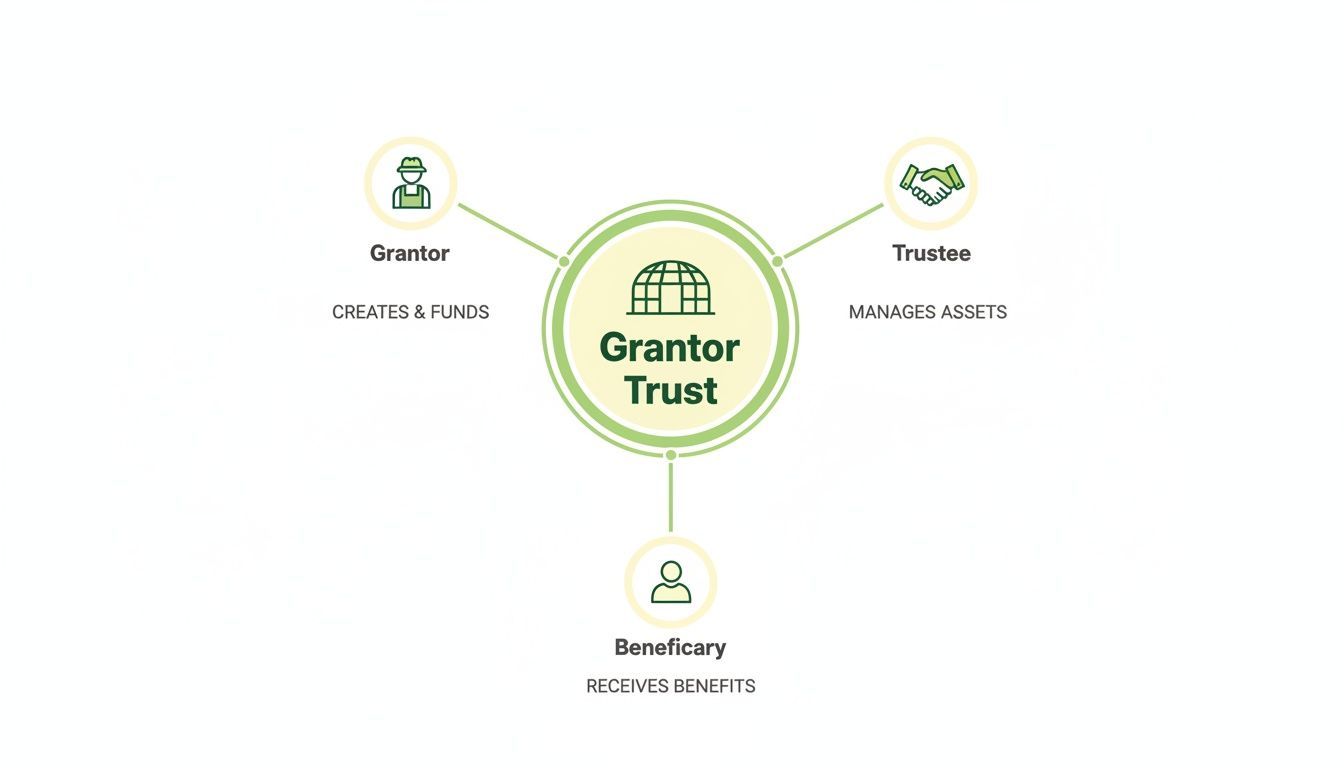
As you can see, you as the grantor are the central figure who sets up and funds the trust. The trustee manages it day-to-day, all for the benefit of your heirs.
The Power of Control and Key Provisions
Certain powers written right into the trust document are what officially make it a grantor trust. While there are a handful of options, a few are incredibly common because of the strategic doors they open.
One of the most popular is the power of substitution. This lets you, the grantor, swap assets of equal value with the trust whenever you want. For example, you could pull high-growth stock out of the trust and replace it with stable cash of the same value. This allows you to personally steer the investment risk while the trust keeps chugging along for your beneficiaries.
Other common grantor powers include:
- The power to borrow from the trust without putting up adequate security.
- Allowing trust income to pay life insurance premiums on a policy covering your life or your spouse's.
- Letting the grantor or their spouse receive distributions from the trust.
These retained powers are precisely what make the trust "defective" for income tax purposes—which is exactly what we're aiming for.
The term 'defective' sounds bad, but in the world of estate planning, an Intentionally Defective Grantor Trust (IDGT) is a brilliant move. The 'defect' is the very feature that forces the grantor to pay the income taxes, turning what seems like a tax burden into a powerful, tax-free gift.
Taxation: The Hidden Superpower
Here’s the most counterintuitive—and powerful—perk of a grantor trust. Because the IRS essentially ignores the trust for income tax purposes, all the income it generates (dividends, interest, capital gains) gets reported on your personal Form 1040.
You pay the taxes out of your own pocket. But this isn't a burden; it's a strategy. Every dollar you pay in taxes on the trust's behalf is a dollar that doesn't have to be drained from the trust's assets. This lets the principal inside the trust grow completely unburdened by income taxes, maximizing its compounding power for your heirs.
Think of it this way: this annual tax payment is essentially a tax-free gift to the beneficiaries, completely separate from and on top of the annual gift tax exclusion.
Revocable vs. Irrevocable Grantor Trusts
Finally, it's critical to know the difference between revocable and irrevocable grantor trusts. This choice has massive implications for your estate.
- Revocable Grantor Trust: Often called a "living trust," you can change or even cancel this type at any time. It's fantastic for avoiding probate, but the assets are still considered part of your taxable estate when you pass away.
- Irrevocable Grantor Trust: Once you set this up and fund it, the trust generally cannot be changed. By giving up that ownership, the assets are officially removed from your taxable estate. This makes it the go-to tool for serious estate tax planning and asset protection.
While both are treated as grantor trusts during your lifetime (meaning you pay the income tax), the irrevocable structure delivers far greater long-term benefits for preserving wealth across generations. It’s a permanent decision, but one that can secure a powerful legacy.
Grantor Trust vs Non-Grantor Trust
To really get a handle on what a grantor trust brings to the table, it helps to see it next to its more traditional cousin, the non-grantor trust. While both are fantastic estate planning tools, they play by completely different rules, especially when it comes to control and taxes. The one you choose will fundamentally shape how your wealth is managed and, just as importantly, who picks up the tax bill.
Think of it like this: a grantor trust is like personally mentoring your family’s wealth. You’re right there in the mix, guiding its growth and covering the taxes. A non-grantor trust, on the other hand, is more like an independent company you’ve set up. It stands on its own two feet, has a trustee running the show, and pays its own way by filing its own tax returns.
The Core Difference in Tax Liability
The biggest distinction boils down to one simple question: who pays the income tax? With a grantor trust, the answer is you, the grantor. For income tax purposes, the IRS essentially pretends the trust doesn't exist—it's a "disregarded entity"—so all the income it generates flows directly onto your personal tax return.
A non-grantor trust is the polar opposite. It's its own taxpayer. The trust itself is required to file an IRS Form 1041 and pay taxes on any income it earns but doesn't hand out to beneficiaries. This gives the trust's assets a completely separate financial life.
The tax brackets for non-grantor trusts are notoriously steep. In 2025, a trust will hit the top federal tax rate of 37% on income over just $15,650. This is a huge reason the grantor trust structure, where income is taxed at your potentially lower individual rates, often looks so much more appealing.
Control and Flexibility: A Tale of Two Trusts
Control is another area where these two structures couldn't be more different. A grantor trust is defined by the specific powers you, the grantor, decide to keep. These powers, like the ability to swap assets or borrow from the trust, are what keep you tethered to the trust for tax purposes and give you that ongoing influence.
This is especially true for revocable living trusts, which offer the most control imaginable. You can dig deeper into our guide to understand what is a revocable living trust and see how it works as a very common type of grantor trust.
With a non-grantor trust, you have to let go. To make sure the trust is treated as a separate taxpayer, you must give up all the specific powers that would otherwise make it a grantor trust. The trustee takes over completely, managing the assets strictly by the rules you originally set down in the trust document, with zero further input from you.
Grantor Trust vs Non-Grantor Trust at a Glance
This table breaks down the fundamental differences between these two trust types, making it easier to see how they line up with different goals.
| Feature | Grantor Trust | Non-Grantor Trust |
|---|---|---|
| Tax Reporting | Income is reported on the grantor's personal tax return. | The trust files its own tax return (Form 1041). |
| Tax Payment | The grantor pays the income taxes. | The trust pays taxes on undistributed income. |
| Grantor Control | Grantor retains specific powers (e.g., asset substitution). | Grantor relinquishes control to the trustee. |
| Primary Use Case | Estate tax reduction and tax-free gifting via tax payments. | Asset protection and income shifting when grantor control is not desired. |
Choosing between these structures is a major decision. One keeps you in the driver's seat for tax and control, while the other creates a truly separate entity. Your long-term financial and family goals will be the ultimate guide.
Common Ways Families Use Grantor Trusts
Knowing the technical details of a grantor trust is one thing, but seeing how it works in the real world is where its value really clicks. These trusts aren't just dry legal documents; they're powerful tools for building a legacy, creating security, and ultimately, giving you profound peace of mind. By looking at a few practical scenarios, you can see how families use them to hit specific, meaningful goals.
These strategies go way beyond simply moving money around. They’re about sending a message, protecting what you’ve worked so hard to build, and setting up the next generation for success. A grantor trust provides the framework to make those intentions a reality, carving out a clear path for your assets to support the people you care about most.

Let's dive into some of the most common ways families put grantor trusts to work, focusing on the very human reasons behind each financial move.
Funding a Grandchild’s Education
One of the most popular uses for a grantor trust is to earmark funds for a grandchild’s future education. Imagine you want to make sure your grandchild can go to college without taking on a mountain of student loan debt. You could set up an irrevocable grantor trust and put a significant sum of money into it.
Because it's a grantor trust, you (the grantor) are on the hook for paying the annual income taxes on any investment growth inside the trust. This is a huge advantage. It means the money in the trust can compound much faster, since it isn't being chipped away by taxes every year.
That tax payment you make is basically an extra, tax-free gift to your grandchild every single year, which really accelerates the growth of their education fund. Your willingness to cover the tax bill ensures the maximum amount of money is ready and waiting when those tuition bills start rolling in.
By paying the income tax on the trust's earnings, a grandparent can supercharge an education fund. This strategic move allows the investment to grow unburdened, effectively maximizing the financial gift without dipping into their annual gift exclusion.
Protecting a Cherished Family Home
Many families have a special property—a longtime family home or a vacation cabin—that holds deep sentimental value. The goal is to keep it in the family for generations, safe from potential future creditors or lawsuits. An irrevocable grantor trust, often structured as a Qualified Personal Residence Trust (QPRT), is the perfect tool for this.
Here’s the game plan: The parents transfer ownership of their home into the QPRT. They get to keep living in it for a set number of years, but legally, the trust owns the house. This one move can shield the home from certain financial risks down the road.
On top of that, this strategy pulls the home's future appreciation out of their taxable estate. If the property value skyrockets over the next decade, that growth happens inside the trust, not in the parents' estate. This could lead to substantial estate tax savings later on.
Transferring Business or Investment Success
Entrepreneurs and investors often turn to more specialized grantor trusts to pass on significant financial wins to their heirs with incredible tax efficiency. A popular choice for this is the Grantor Retained Annuity Trust (GRAT).
Let's say an entrepreneur expects her company’s stock to jump in value. She could place a block of that stock into a GRAT. In return, she receives a fixed annual payment (an annuity) back from the trust for a specified term.
The magic happens with the investment growth. If the stock's value grows faster than the interest rate set by the IRS, all of that extra appreciation passes to her children completely free of gift tax. This strategy allows business owners and investors to transfer millions in wealth while using very little, if any, of their lifetime gift tax exemption. This is a more advanced but common way to handle large-scale gifting, a topic you can learn more about in our guide on how to gift money tax-free.
Ultimately, each of these scenarios shows that a grantor trust is far more than its definition. It's a flexible and effective instrument for achieving deeply personal family goals, from education and protection to legacy and entrepreneurship.
Navigating Tax and Legal Implications
When you set up a grantor trust, you're not just moving assets around; you're stepping into a specific tax and legal framework. Think of these rules less as obstacles and more as the guardrails that make the whole strategy work. Understanding them is what unlocks the real power of this tool.
The moment you transfer assets into an irrevocable grantor trust, you're making what's known as a completed gift. This action taps into your lifetime gift tax exemption—the total amount you can give away while you're alive without triggering federal gift taxes.
This isn't just a technicality; it's a powerful strategic move. By using your exemption to fund the trust, you're officially taking those assets and all their future appreciation out of your taxable estate. For families looking to preserve wealth, this one step can dramatically reduce the estate tax bill their heirs will one day face.
Estate Tax Reduction: The Primary Goal
The biggest win with an irrevocable grantor trust is its ability to slash—or even completely wipe out—future estate taxes. Once assets are properly placed inside this type of trust, they are no longer legally yours for estate tax purposes.
Let's play this out. Say you put $1 million worth of stock into an irrevocable grantor trust. Over the next 20 years, that stock mushrooms in value to $4 million. Because the trust owned the stock, that entire $3 million of growth happened outside your taxable estate. This means it can pass to your beneficiaries without getting hit by the estate tax, which can run as high as 40%. You can dive deeper into this by reading our guide on what is estate tax exemption and how it works.
A huge misconception is that any trust will dodge the estate tax. That’s not true. Only irrevocable trusts—where you’ve permanently given up specific rights to the assets—can pull this off. Your standard revocable living trust, on the other hand, remains part of your taxable estate.
Asset Protection: A Shield for Your Wealth
Beyond the tax savings, an irrevocable grantor trust acts like a financial fortress. Once you move assets into the trust, they're generally shielded from your future personal creditors, lawsuits, or even bankruptcy. Why? Because you don't legally own them anymore. The trust does.
This is a massive source of peace of mind, especially for doctors, lawyers, business owners, or anyone in a high-liability profession. It draws a clean line between your personal financial risks and the legacy you're working so hard to build for your family.
A few legal points to keep in mind:
- Timing is everything: You have to create and fund the trust when you are financially healthy. Trying to move assets to hide them from existing creditors is a big no-no and can be challenged in court as a fraudulent transfer.
- State laws matter: Asset protection rules can vary quite a bit from state to state. This is where getting expert legal advice is non-negotiable.
- It must be irrevocable: To get this powerful protection, you have to give up your right to simply take the assets back.
By getting a handle on these details, you and your advisory team can design a grantor trust that doesn’t just pass wealth efficiently but also builds a durable financial shield for generations to come. It’s a deliberate process, one that rewards foresight and a clear vision of your long-term goals.
A Step-By-Step Overview for Setting Up a Grantor Trust
Putting together a grantor trust might sound intimidating, but it’s a journey you can absolutely manage when it's broken down into clear, logical steps. This isn't a DIY guide—you'll want pros on your side—but knowing the roadmap will give you the confidence to work with them effectively. Think of it as drawing up a detailed blueprint before you start building your family’s financial legacy.
The entire process is about turning your intentions into a solid legal structure that protects what you’ve built and provides for the people you care about most. Every single step is a deliberate move to bring that vision to life.

Step 1: Define Your Goals
Before a single document gets drafted, the most critical step is getting crystal clear on your "why." What do you want your money to accomplish? Are you trying to fund your grandkids' education, shield the family home from creditors, trim down estate taxes, or make sure your business passes smoothly to the next generation?
Your specific goals will dictate the kind of grantor trust you need and which powers to include. This is the foundation everything else is built on. Get this right, and the rest falls into place.
Step 2: Assemble Your Professional Team
Creating a grantor trust is a team sport, not something you should tackle alone. You’ll need an experienced estate planning attorney to draft the legal documents and ensure they’re compliant with all the relevant federal and state laws.
Most families also bring their financial advisor and accountant into the loop. This collaboration is key—it ensures the trust perfectly aligns with your big-picture financial plan and that all the tax implications are handled correctly right from the start.
Step 3: Draft and Finalize the Trust Document
Once your goals are set and your team is in place, your attorney will start drafting the trust agreement. This is where the rubber meets the road and you'll make some crucial decisions:
- Choosing a Trustee: You'll name someone (and a backup, or successor trustee) to manage the trust. This is a huge decision.
- Defining Beneficiaries: You'll spell out exactly who benefits from the trust and under what circumstances.
- Selecting Grantor Powers: Your attorney will walk you through choosing the right powers, like the power of substitution, to make sure the trust works exactly as you intend.
The drafting phase is your chance to build in both flexibility and precision. A well-written trust anticipates future needs and clearly outlines the trustee's duties, which is the best way to prevent confusion and family arguments down the road.
Step 4: Fund the Trust
Here’s a step people often forget: a trust is just an empty box until you actually put something in it. This final, critical step involves legally retitling your assets—like your house, investment accounts, or business interests—into the name of the trust.
Your attorney and financial advisor will guide you through this process to make sure ownership is transferred correctly. Skipping this step is a common and costly mistake that can make the entire trust useless. Properly funding it is what officially puts your entire plan into action.
Common Questions About Grantor Trusts
Once you start digging into the details of a grantor trust, the practical questions always follow. It’s one thing to understand the concept, but it's another to see how it fits into your life. Getting straight answers is what turns a good idea into a confident plan.
Let's walk through some of the most common questions families ask when they're figuring out if a grantor trust is the right move for them.
Can I Be the Trustee of My Own Grantor Trust?
This one comes up all the time, and for good reason—it’s about control. The answer really depends on what kind of trust you’re setting up.
-
For a Revocable Trust: Yes, absolutely. In fact, most people who create a revocable living trust name themselves as the first trustee. This gives you direct, hands-on control to manage your assets for as long as you're able.
-
For an Irocrevocable Trust: This is where you need to be careful. Appointing yourself trustee of an irrevocable trust is almost always a bad idea. It muddies the waters, and the IRS could easily argue that you never really gave up control. If they win that argument, the trust’s assets could be pulled right back into your taxable estate, completely defeating the purpose.
The standard play here is to name an independent third party as trustee. This could be a trusted family member, a close friend, or a professional corporate trustee. That separation is what preserves the powerful estate tax and asset protection benefits of the trust.
What Happens to the Trust When the Grantor Dies?
The grantor’s passing is the trigger that fundamentally changes the trust. It’s a major transition point where the trust takes on a new life of its own.
For tax purposes, the trust instantly converts from a grantor trust into a non-grantor trust. It stops being an extension of you and becomes its own separate taxpayer. From that point on, it has to file its own annual tax return (Form 1041).
The successor trustee you named in the trust document officially steps in to take the reins. Their job is to follow the rulebook you wrote—your instructions. That might mean distributing assets to your kids right away, holding assets in the trust for their benefit over many years, or some combination of the two. With a revocable trust, the assets are counted as part of your estate for tax purposes. For a well-drafted irrevocable trust, they stay outside of it.
How Much Does It Cost to Create a Trust?
Setting up a grantor trust is an investment in your family’s financial security, not just another legal bill. Costs can vary depending on how complex your situation is and where you live, but you should expect the legal fees for a professionally drafted trust to be at least a few thousand dollars.
While that upfront cost is more than you’d pay for a simple will, a trust often saves a massive amount of money and headaches on the back end. By avoiding the time and expense of probate, potentially slashing estate taxes, and shielding assets from creditors, the initial investment pays for itself many times over. It's less of an expense and more like buying some very valuable peace of mind.
