

When you're married, the best social security strategies for married couples aren't about your benefit versus your spouse's benefit. It’s all about working together to squeeze every possible dollar out of the system for your household over your entire lifetime.
A smart approach often means the higher-earning spouse hits the pause button, waiting until age 70 to claim. This single move locks in the largest possible monthly check, which dramatically boosts the survivor benefit for whoever lives longer.
Your Guide to Social Security as a Couple

Planning for retirement as a team is one of the biggest financial hurdles you'll ever tackle together. Getting your Social Security decisions right can add tens, or even hundreds, of thousands of dollars to your shared nest egg. It's shocking how many couples leave that money on the table simply because they never sat down to create a coordinated game plan.
This guide is here to cut through the confusion and give you clear, actionable strategies designed for you and your spouse. Stop thinking of your benefits as two separate paychecks. Instead, picture them as interconnected gears in a single, powerful financial engine built for your family.
Building a Shared Financial Future
We'll walk through the different types of benefits available and show you how simple timing and coordination can radically change your financial picture. The big idea here is to shift your mindset from "my money" versus "your money" to "our total household benefit."
This approach hinges on a few key ideas:
- Lifetime Income: The goal isn't the biggest check next month, but the most total money you'll receive over both of your lifetimes.
- Survivor Protection: Making sure the surviving spouse is left with the largest possible income safety net is a huge priority.
- Tax Efficiency: You want to claim your benefits in a way that minimizes the tax bite on the rest of your retirement funds.
For most couples, the most powerful lever you can pull is having the higher earner wait as long as possible—ideally until age 70—to file for their benefit. Think of this strategy as a form of longevity insurance; it locks in a bigger, inflation-adjusted income stream for as long as either of you lives. It also guarantees the maximum possible survivor benefit, which is critical since one of you will almost certainly outlive the other.
The goal is to make your benefits work together, not separately. A coordinated approach leverages the rules to your advantage, creating a more secure and predictable retirement income for both of you.
Getting these concepts down is the first step toward making decisions you can feel good about. And keep in mind, things can always change. Potential new laws, like those proposed in the Social Security Fairness Act, could also shake up your future plans. From here, we'll build on these core ideas and move into more advanced tactics.
Getting to Know Your Core Social Security Benefits
Before you can build a smart Social Security strategy, you have to know what tools you’re working with. For married couples, Social Security isn't just one benefit—it's a set of four distinct options. Think of them as different tools in a specialized toolkit. Knowing which one to grab, and when, is the secret to building a retirement that truly works for you both.
Understanding how these four benefits connect and interact is the first step toward pulling every dollar you're entitled to from the system.
Your Own Retirement Benefit
This one’s the foundation. It's the benefit you've earned through your own sweat and taxes paid over your working years. The Social Security Administration calculates this based on your average monthly earnings over your 35 highest-earning years.
If you and your spouse both have solid work histories, you’ll each have your own retirement benefit. These two individual benefits are the starting point for all your planning, since every other benefit is calculated based on these core amounts.
The Spousal Benefit
This is where the teamwork really pays off. The spousal benefit is a game-changer, especially for couples where one person earned significantly more than the other over their careers. It allows a spouse to claim a benefit based on their partner's work record, not just their own.
Here's the deal: the maximum spousal benefit is 50% of the higher-earning spouse's benefit at their full retirement age (FRA). For instance, if your spouse's FRA benefit is $3,000 a month, your spousal benefit could be as high as $1,500. The catch? You can't start receiving it until your spouse has filed for their own benefits.
Don't worry, this doesn't take a dime out of your spouse's check; it's an extra payment from Social Security. It was designed to support a spouse who might have spent time out of the workforce raising a family or working part-time.
Here's a key rule to remember: Social Security will always give you the bigger of two options—your own retirement benefit or your spousal benefit. You don't get to stack them and collect both in full.
This benefit is a powerful but often overlooked piece of the retirement puzzle. According to recent data, as of August 2025, about 2.07 million spouses were receiving these benefits, with an average monthly check of $954.93. The actual amount you get can range from 32.5% to 50% of your partner’s full benefit, depending on how early you decide to claim. You can find more insights about Social Security benefit amounts on Kiplinger.com.
The Survivor Benefit
This benefit is your financial safety net. When one spouse passes away, the surviving spouse can step into the deceased's Social Security benefit if it's larger than their own. A surviving spouse can receive up to 100% of what their late partner was receiving (or was entitled to receive at their full retirement age).
This is exactly why having the higher-earning spouse wait to claim is often such a powerful move. By delaying, they don't just boost their own monthly check—they permanently increase the potential survivor benefit for their partner. It’s a decision that provides a lifetime of greater financial security.
The Divorced-Spouse Benefit
Even if a marriage doesn't last, some of the Social Security ties can. If you were married for 10 years or more, are currently unmarried, and you’re at least 62, you might be able to claim benefits based on your ex-spouse's work record.
It works a lot like the spousal benefit, and your claim has absolutely no impact on your ex-spouse or their current family. It won't reduce their benefit or prevent their new spouse from claiming. It’s a separate entitlement that acknowledges the financial partnership you had.
To help you see how these options stack up, let's put them side-by-side.
Comparing Social Security Benefits for Married Couples
This table gives you a quick snapshot of the four main benefits you and your spouse will be working with. Understanding the key differences is the first step in coordinating your claims.
| Benefit Type | Who Is Eligible? | How Is It Calculated? | Key Strategic Point |
|---|---|---|---|
| Retirement Benefit | Individuals with enough work credits (typically 40). | Based on your top 35 years of earnings. | Delaying your claim to age 70 significantly increases your monthly payment. |
| Spousal Benefit | Spouses of eligible workers, typically at least 62 years old. | Up to 50% of the primary worker's full retirement age benefit. | Provides a valuable income boost for a lower-earning spouse. |
| Survivor Benefit | Widows or widowers, typically at least 60 years old. | Up to 100% of the deceased spouse's benefit. | A critical safety net; maximized when the higher earner delays their claim. |
| Divorced-Spouse Benefit | Ex-spouses from a marriage lasting 10+ years. | Similar to the spousal benefit calculation. | Your ex-spouse's marital status does not affect your eligibility. |
Now that you've got a handle on the four tools in your Social Security toolkit, you can start to see how they might fit together. The next piece of the puzzle is figuring out the timing—when to use each tool to build the most secure financial future for your family.
The Critical Role of Timing Your Claims
Deciding when to start taking Social Security is single-handedly the most important decision you and your spouse will make for your retirement. It’s a classic case of a bird in the hand versus two in the bush, and there’s no one-size-fits-all answer.
Think of your benefits like a faucet. You can turn on the tap at age 62 and get a smaller, but immediate, stream of income. Or, you can wait, letting the pressure build, and get a much stronger flow later on. Claiming early gives you cash now, but it means accepting a permanently smaller monthly check for the rest of your life. Waiting past your Full Retirement Age (FRA) does the opposite, creating a larger, inflation-proof income stream that can provide serious security for both of you.
The Power of Delayed Gratification
Here's a number that should grab your attention: for every year you delay claiming Social Security past your FRA (up to age 70), your future monthly benefit jumps by a guaranteed 8%. This isn't some risky market return; it's a built-in feature of the system. If your FRA is 67, waiting until 70 means your benefit will be 24% higher than it would have been—for life.
For a married couple, this isn't just an individual math problem. It’s a team decision with ripple effects that can last for decades, especially for the surviving spouse.
When the higher-earning spouse delays their claim, they are not just increasing their own check. They are simultaneously maximizing the potential survivor benefit, creating a powerful financial safety net for their partner.
This strategy is about more than just numbers; it’s about looking out for each other. If the higher earner passes away first, the surviving spouse steps into the largest possible monthly payment. This transforms a personal claiming decision into an act of lifelong protection for your partner, providing critical stability during a tough time.
The chart below gives you a visual of how spousal benefits are designed to work alongside your own retirement income, offering a vital boost for many families.
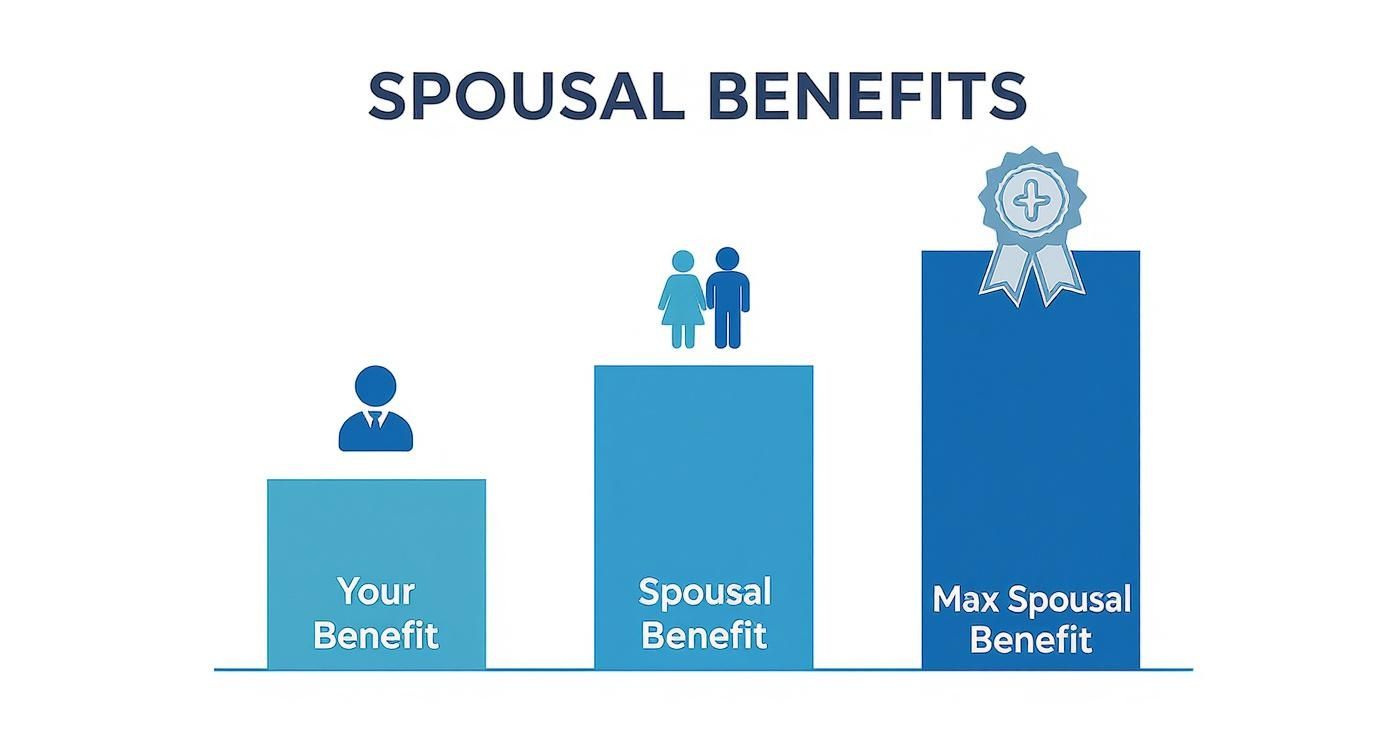
As you can see, while your own benefit is the foundation, the spousal benefit can significantly lift a lower-earning partner's income up to the maximum level allowed.
Introducing Break-Even Analysis
So, how do you actually decide when to pull the trigger? One practical tool is the "break-even analysis." Put simply, this is the age at which the total money you get from waiting to claim finally catches up to the total money you got by claiming early. If you live past this age, waiting was the winning move.
Running this analysis isn't just about crunching numbers, though. It involves a serious conversation about a few key factors:
- Health and Life Expectancy: This requires an honest look at reality. If you both are in great health with a family history of living into your 90s, waiting often makes a ton of sense.
- Other Retirement Savings: Do you have enough in your 401(k)s and IRAs to bridge the gap and live comfortably while you let your Social Security benefits grow?
- Income Needs: Can you truly afford to postpone this income, or do you need it now to cover your bills and enjoy your early retirement years?
This isn’t just a math problem; it's a deeply personal decision that gets to the heart of your shared goals. It requires sitting down together and talking openly about your health, your money, and what you both want out of retirement. Weighing these variables is a core part of building a strategy that feels right for your family.
Getting the mechanics down is the first step, but you can dive deeper into how to maximize Social Security benefits in our detailed guide. Nailing the timing choice sets the stage for every other strategic decision you'll make.
Coordinating Claims for Maximum Household Income
Real financial teamwork in retirement means looking beyond your individual benefit checks and focusing on one powerful number: your total household income. Think of your two Social Security benefits not as separate paychecks, but as interlocking pieces of a bigger financial puzzle. The goal is to arrange those pieces in a way that generates the most income over both of your lifetimes.
This takes a bit of strategy. Instead of both spouses simply claiming whenever they feel like it, you can create a deliberate plan. For example, one spouse might start their benefits early to get some cash flowing, while the other waits, letting their future benefit grow into a much larger, more durable income stream for your family down the road.
The Split Strategy: A Popular Approach
One of the most effective social security strategies for married couples is what many call the "split strategy." This approach is a real game-changer, especially when there’s a significant age or earnings gap between spouses. It’s a simple but brilliant way to get the best of both worlds: immediate income and long-term growth.
Here’s the basic playbook:
-
The Lower Earner Claims First: The spouse with lower lifetime earnings (or the one who is older and ready to retire) claims their benefit, often as early as age 62. This opens the tap for an immediate income stream to help fund your early retirement years.
-
The Higher Earner Delays: At the same time, the higher-earning spouse holds off on claiming, ideally waiting until age 70. For every year they wait past their Full Retirement Age (FRA), their future monthly check gets a guaranteed 8% bump.
This move maximizes your largest potential benefit. That not only means a higher income for both of you later on but also locks in the highest possible survivor benefit for whichever spouse lives longer.
Navigating the Social Security Earnings Test
So, what happens if one or both of you want to keep working while drawing benefits? This is where you need to know about the Social Security earnings test. If you claim benefits before you hit your Full Retirement Age and keep earning money from a job, a portion of your benefits might be temporarily withheld.
It’s important to understand this isn't a penalty—that money isn't gone forever. The withheld amount is actually added back into your benefit calculation once you reach FRA. Still, it can definitely affect your cash flow in the short term.
The earnings limits change, so you’ll want to keep an eye on them. For 2025, the annual earnings limit for those who won't reach FRA is $23,400. For people who will reach their FRA during 2025, the limit is much more generous at $62,160. Knowing these rules is a must for any couple planning a phased retirement. You can discover more insights about the 2025 Social Security changes on OldNational.com.
This earnings test only applies to income from work. It does not affect income from pensions, investments, or other retirement accounts, giving you more flexibility in how you structure your finances.
And the best part? Once you reach your Full Retirement Age, the earnings test vanishes completely. You can earn as much as you want from a job without a single dollar being withheld from your Social Security payments.
Real-World Scenarios: Putting It All Together
Let's look at how these coordination strategies might actually play out. The right choice is deeply personal and depends entirely on your family's unique situation—your ages, health, work histories, and other savings all come into play.
Scenario 1: The Traditional Split
- The Couple: Robert (67) and Susan (62). Robert was the higher earner throughout their careers.
- The Strategy: Susan claims her own reduced benefit at 62, bringing in some immediate income. Robert, meanwhile, delays his claim all the way to age 70.
- The Outcome: They use Susan’s smaller benefit plus some withdrawals from their 401(k) to live on for the next three years. When Robert finally claims at 70, his benefit is a full 24% larger than it would have been at his FRA. This gives them a massive boost in monthly income and maximizes Susan’s potential survivor benefit if she outlives him.
Scenario 2: Both Spouses Delay
- The Couple: David and Maria, both 64, with similar high earnings and in good health.
- The Strategy: They have enough in their retirement savings to cover their expenses for a few years. Confident in their health and finances, they both decide to wait until age 70 to claim benefits.
- The Outcome: By waiting, both of their benefits grow significantly. This strategy gives them the largest possible combined lifetime income, acting as a powerful insurance policy against the risk of outliving their money.
As you can see, there’s no single "best" answer that fits everyone. The most powerful approach is the one that aligns with your family's financial picture and retirement dreams, turning two individual benefits into a unified and robust source of household income.
How Taxes and Healthcare Costs Impact Your Strategy
Your Social Security decisions don't exist in a vacuum. They’re a huge piece of your complete financial puzzle, and the benefit amount you see on paper is rarely what hits your bank account. Real-world costs like federal taxes and healthcare premiums can take a significant bite, which is why you have to look at the whole picture.
Thinking about your Social Security check in isolation is like planning a road trip by only looking at the start and end points, completely ignoring the cost of gas, tolls, and surprise repairs along the way. To really get a handle on your retirement income, you have to account for these deductions. Let's break down how to build a plan that stands up to the realities of taxes and medical expenses.
Understanding Provisional Income and Taxes
Here's something that surprises a lot of retirees: your Social Security benefits can be taxable. The IRS has a special formula to figure this out, and it all comes down to a concept called "provisional income."
You won't find this number on any standard financial statement. It’s a specific calculation that includes:
- Your adjusted gross income (AGI): This is everything from wages and pensions to withdrawals from traditional 401(k)s or IRAs.
- Your nontaxable interest: Think income from municipal bonds.
- Half of your Social Security benefits: This is the key ingredient that often pushes couples over the line into a taxable bracket.
Once you add those three up, you compare the total to the IRS thresholds. For married couples filing jointly in 2025, if your provisional income is between $32,000 and $44,000, up to 50% of your benefits might be taxable. If your income climbs above $44,000, up to 85% of your benefits could be hit with income tax.
Strategic withdrawals from your retirement accounts directly influence your provisional income. By carefully managing how much you pull from traditional IRAs or 401(k)s each year, you can potentially keep your income below these key thresholds and reduce the tax bite on your Social Security.
This is exactly why coordinating your social security strategies for married couples with a tax-aware withdrawal plan is so critical. For instance, leaning more on tax-free Roth IRA distributions in certain years can help keep that provisional income number down.
The Real Impact of Medicare Premiums
Another major player that affects your net Social Security payment is healthcare. For most retirees, Medicare Part B premiums are deducted right from their Social Security checks. This means the nice little boost you get from a Cost-of-Living Adjustment (COLA) can be partially—or even completely—erased by rising medical costs before you ever see a dime.
You can see this dynamic play out clearly with the 2025 projections. The modest 2.5% COLA is expected to add about $49 per person to the average Social Security payment. For a couple, that’s a $98 monthly raise. But hold on—Medicare Part B premiums are also set to go up by $10.30 per month. That premium is taken out automatically, so the $20.60 monthly increase for the couple immediately eats into their net gain from the COLA. You can read more about the 2025 Social Security changes on AARP.org.
This direct link between Social Security and Medicare really drives home how important it is to plan for healthcare costs. A larger Social Security check doesn't just mean more income; it creates a bigger buffer against the steady, predictable rise in medical expenses throughout your retirement. A strategy that maximizes your gross benefit simply gives you more firepower to handle these inevitable deductions.
Putting It All Together: Your Social Security Game Plan
Alright, we've covered a lot of ground. But knowing the rules is one thing; applying them to your own life is where the real magic happens. This is the moment we move from theory to action and build a Social Security plan that actually fits your family.
Think of it less like crunching numbers and more like designing the future you and your spouse have always talked about. This is about building security and peace of mind, together. It’s a series of honest conversations that will give you the confidence to make the best calls for your household.
Your Actionable Checklist
To build a smart strategy, you need a solid foundation. That means gathering a few key pieces of information and having some candid talks with your partner. This isn’t guesswork; it’s about grounding your decisions in reality.
Here’s a simple, step-by-step framework to get you started:
-
Grab Your Latest Statements: The first stop is the Social Security Administration's website. Log into your
mySocialSecurityaccounts to get the most accurate, up-to-date estimates for your retirement, spousal, and survivor benefits at different claiming ages. - Talk About Health and Longevity: This one can be a little sensitive, but it's essential. Have an open conversation about your health, your family's history of longevity, and what you realistically expect. This heavily influences whether delaying your benefits makes sense for you.
- Map Out All Your Retirement Assets: Social Security is just one piece of the puzzle. You need to see how it fits with everything else. Take a complete inventory of your 401(k)s, IRAs, pensions, and any other savings. This will tell you if you have the resources to "bridge the gap" if you decide to delay your benefits for a bigger payout later.
This planning phase is about so much more than just squeezing every last dollar out of the system. It’s about making sure your financial strategy lines up with your life goals, protecting the surviving spouse, and creating a legacy of thoughtful, intentional decisions.
Crafting Your Shared Vision
Once you have the data, it’s time to talk about what you both actually want out of retirement. Are you dreaming of traveling the world in your early years? Or is a quieter life more your speed? Does one of you plan on working part-time for a while?
Answering these questions helps set your priorities. If big adventures are at the top of the list, a strategy that brings in income right away might be more appealing, even if it means a smaller lifetime benefit. On the other hand, if long-term financial security and maximizing the survivor benefit are your main goals, then delaying your claims becomes a much more powerful move.
This dialogue turns a complex financial puzzle into a shared project. The best social security strategies for married couples are always the ones built on mutual understanding and a unified vision for what’s next. By following this framework, you're not just picking a claiming date—you're actively designing the retirement you both deserve.
Common Questions About Social Security for Couples
Navigating Social Security can feel like trying to solve a puzzle with a thousand tiny pieces. But once you grasp a few of the core rules, the bigger picture starts to come into focus. As you and your spouse map out your retirement, some questions pop up again and again.
Getting straight answers to these common sticking points is the key to building a Social Security strategy that you can feel confident about.
Can I Collect My Own Benefit and a Spousal Benefit at the Same Time?
This is probably one of the most frequent questions, and the answer is a firm no—you can't "double-dip" by collecting two full benefits. The Social Security Administration (SSA) has a straightforward rule: you'll get the higher of the two benefits you're eligible for, not both combined.
Here’s how it works in practice. The SSA will always pay your own earned retirement benefit first. If the spousal benefit you qualify for is higher than your own, you'll receive your benefit plus an extra amount to bring your total payment up to that higher spousal benefit amount.
For example, if your own benefit is $900 a month and you're eligible for a spousal benefit of $1,200, your total monthly payment will be $1,200. It won't be $2,100. This is a fundamental design of the system, meant to provide a floor, not a windfall.
What Happens to My Spousal Benefit if My Spouse Dies?
When your spouse passes away, your spousal benefit will stop. But this is where another, even more critical benefit takes its place: the survivor benefit. This is a financial safety net designed specifically for this situation, and it’s almost always a higher amount than the spousal benefit was.
A survivor benefit can be up to 100% of what your deceased spouse was receiving when they passed. And just like with spousal benefits, you won't get both your own benefit and the full survivor benefit. The SSA will pay you whichever amount is higher.
This transition is precisely why having the higher-earning spouse delay their claim is such a powerful long-term strategy. It maximizes this potential safety net, providing the surviving spouse with the largest possible income for the rest of their life.
How Does My Claiming Decision Affect My Spouse?
Your decision on when to claim benefits isn't just about you—it has a direct and significant impact on your spouse in two major ways.
First, your spouse can't even begin to claim a spousal benefit on your record until you've officially filed for your own retirement benefits. Your action is what unlocks their ability to claim that income stream.
Second, and most critically, your claiming age determines the size of their potential survivor benefit. When the higher earner in a couple delays claiming their benefit until age 70, they permanently lock in a higher monthly payment for life. That decision then becomes the new, higher baseline for the survivor benefit, transforming a personal timing choice into an incredible act of financial protection for your partner.
While your decisions have a big impact, it's worth remembering that some external life events might not. For instance, you can learn more about if an inheritance will affect your Social Security retirement benefits in our separate guide.
At Smart Financial Lifestyle, we believe in making smart financial decisions that create security and peace of mind for your entire family. To build a retirement plan that reflects your values and protects your legacy, explore our resources at https://smartfinanciallifestyle.com.
