

A healthcare power of attorney is a legal document that gives you the power to name someone you trust to make medical decisions for you. This person, known as your healthcare agent, only steps in if you become unable to speak for yourself.
It’s about being proactive and making sure your values and wishes are always front and center in your medical care, no matter what curveballs life throws your way.
A Co-Pilot for Your Medical Journey

Think of your Healthcare Power of Attorney (HPOA) as choosing a trusted co-pilot for your health. If you’re ever unconscious or can’t communicate, this person steps in to navigate the twists and turns of medical care for you. They become your voice, making sure doctors and nurses understand exactly what you would want.
This isn’t just some document for the end of life; it’s a crucial tool for any adult over 18. An unexpected illness or a sudden accident can happen at any age. Without an HPOA, those critical decisions could fall to family members who might disagree, or even worse, a court might have to step in. Having one in place brings incredible peace of mind.
To give you a clearer picture, here’s a quick breakdown of what a Healthcare Power of Attorney involves.
Healthcare Power of Attorney at a Glance
| Component | What It Means for You |
|---|---|
| Principal | This is you—the person creating the document and granting authority. |
| Healthcare Agent | The trusted individual you choose to make medical decisions on your behalf. |
| Activation | The document only becomes active when a doctor certifies you cannot make your own decisions. |
| Authority | Your agent can make choices about doctors, treatments, surgery, and end-of-life care. |
| Your Wishes | You can provide specific instructions to guide your agent's decisions, ensuring your voice is heard. |
This table shows how an HPOA puts you in the driver's seat, even when you can't communicate your wishes directly.
Why Is This Document So Important?
An HPOA empowers your chosen person to make a whole range of decisions, ensuring the care you receive lines up with your personal beliefs. This includes choices about things like:
- Which doctors and medical facilities to use
- Approving or denying medical treatments, tests, or surgeries
- Decisions about life-sustaining measures and end-of-life care
At its core, it prevents confusion and conflict during what is already a deeply stressful time for your loved ones. Your agent acts as your personal advocate, making sure your voice is heard loud and clear.
A Healthcare Power of Attorney isn't about giving up control. It’s about extending your control over your own medical care into a future where you might not be able to communicate.
Despite how critical this is, a lot of people haven't taken this simple step. Shockingly, only 37% of U.S. adults have completed a health care directive like an HPOA, often because the idea just isn't well understood. You can discover more insights about why these documents are so vital at CertaintyNews.com.
This guide is designed to give you the solid understanding you need to take charge of your future healthcare choices.
Understanding Your Healthcare Agent's Role
Once you’ve named someone in your Healthcare Power of Attorney (HPOA), you’ve handed them a profound responsibility. This person, your healthcare agent, becomes your dedicated advocate and decision-maker if you’re ever unable to speak for yourself. This isn't just a title on a piece of paper; it’s an active, hands-on role with significant legal authority.
Their primary job is to step into your shoes and make the medical choices you would make. Think of them as your voice when you don't have one. This authority is broad and touches nearly every aspect of your care.
The Scope of an Agent's Authority
Your agent's power is designed to be comprehensive, allowing them to make critical decisions during what could be a very vulnerable time. Their responsibilities typically give them the authority to:
- Consent to or refuse medical treatments. This covers everything from routine procedures and medications to major surgeries and life-sustaining treatments like ventilators or feeding tubes.
- Choose or discharge your healthcare providers and facilities. They can decide which doctors, specialists, or hospitals are best suited for your care, and they can arrange for transfers if needed.
- Access your protected medical information. Under HIPAA, your agent has the right to review your medical records to make fully informed decisions that align with your condition and wishes.
This authority is designed to ensure there is a single, clear voice advocating for you. It helps prevent confusion or painful disputes among family members during a crisis.
The core of the agent's role is not to decide what they want for you, but to faithfully represent what you would have wanted for yourself. This requires a deep, personal understanding of your values, your beliefs, and what quality of life really means to you.
An Agent in Action: A Real-World Scenario
Let's make this real. Imagine you're in a serious car accident and are unconscious in the hospital. The doctors say you need emergency surgery, but there are two options—one is more aggressive with a higher risk but a potentially better outcome, and the other is safer but might lead to a much longer recovery.
Without an HPOA, doctors might have to consult with several family members who could disagree on the best path forward, causing stressful delays. But with an HPOA, your designated agent steps in. Because you’ve already talked about your views on medical risk and quality of life, they can confidently speak with the surgical team, review the options, and authorize the procedure that best reflects your preferences. They become your voice, ensuring your personal values guide your medical journey.
It's really important to distinguish this role from financial responsibilities. While your healthcare agent manages your medical care, a completely different Power of Attorney is needed for financial matters. You can learn more about the unique duties involved in managing money by reading our guide on the power of attorney financial responsibilities. This separation of duties is smart—it ensures both your health and your assets are managed by the people best suited for each job.
When you start planning for your future healthcare, you quickly run into a whole alphabet soup of legal documents. It’s easy to get lost in terms like HPOA, Living Will, POLST, and DNR. They all play a part, but they do very different jobs. Getting these straight is the key to creating a plan that truly protects you and your wishes.
Think of it like this: your overall advance care plan is a team of specialists, and each one has a specific role. Your Healthcare Power of Attorney (HPOA) is the team captain—the person on the ground who can call the plays and make real-time decisions. The other documents are like the playbook, providing clear instructions for very specific situations.
Living Will: The Instruction Manual
A Living Will is your written instruction manual for end-of-life care. It’s where you spell out exactly what you want—or don’t want—if you can no longer speak for yourself. This document deals with specific treatments like ventilators or feeding tubes. It’s a direct message from you to your doctors.
The catch? A Living Will is static. It’s just a piece of paper that can’t possibly predict every medical scenario that might come up. That’s where your HPOA is so critical. Your agent can take the spirit of your Living Will and apply it to situations you never could have imagined.
POLST: A Doctor's Order for the Seriously Ill
A Physician Orders for Life-Ssustaining Treatment (POLST) form is a different beast entirely. It isn’t for everyone. This is a powerful medical order for people who are already facing a serious, advanced illness. It takes your wishes and turns them into actionable commands that emergency responders and other doctors are legally required to follow.
A POLST is far more specific than a Living Will and must be signed by both you (or your agent) and your doctor. It’s designed to travel with you from the hospital to a nursing home, making sure your immediate treatment preferences are honored no matter where you are.
DNR: The Focused Directive
A Do Not Resuscitate (DNR) order is the most specific and focused of these documents. It’s a simple, direct instruction telling medical staff not to perform CPR if your heart or breathing stops. A DNR is typically put in place for someone who is terminally ill or has a condition where CPR would likely do more harm than good.
The concept map below helps visualize the key functions your healthcare agent performs. It really drives home their active role in making decisions, gathering information, and being your advocate.
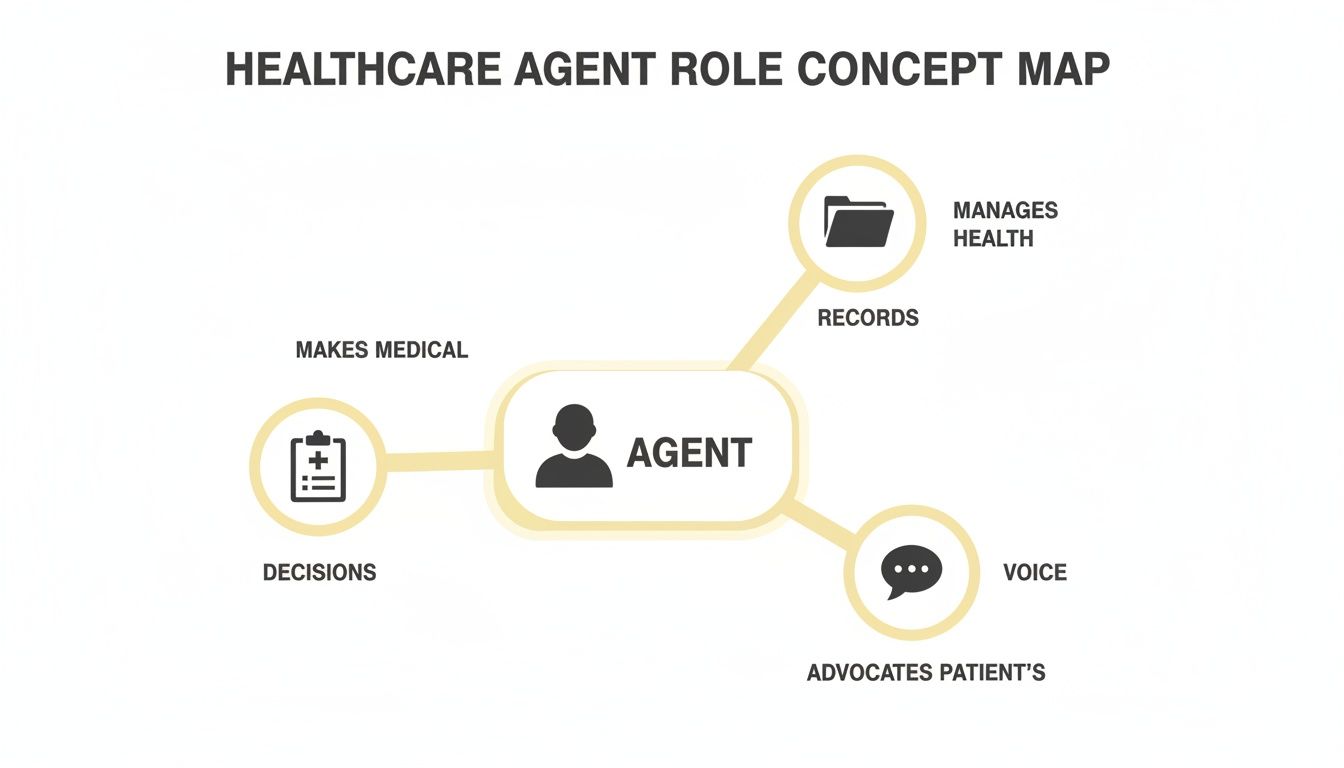
This graphic makes it crystal clear that your agent isn't just a name on a form. They are an active participant who has to manage information and be your voice when you can’t use your own.
To make these differences even clearer, this table breaks down the purpose and function of each document side-by-side.
Comparing Key Advance Care Planning Documents
| Document Type | Primary Purpose | When It's Used | Flexibility |
|---|---|---|---|
| Healthcare Power of Attorney | Appoints a person (agent) to make medical decisions on your behalf. | When you are unable to communicate your own wishes, for any medical reason. | High. The agent can interpret your wishes for unforeseen situations. |
| Living Will | States your wishes for end-of-life medical treatment. | When you are terminally ill or permanently unconscious and can't consent. | Low. It only applies to the specific instructions you've written down. |
| POLST | Translates your wishes into a direct medical order for life-sustaining treatment. | For individuals with a serious, advanced illness, across all care settings. | Moderate. It's very specific but can be updated with your doctor. |
| DNR Order | Instructs medical personnel not to perform CPR if your heart or breathing stops. | Typically used when CPR would be medically futile or unwanted. | Very Low. It applies only to the single decision of resuscitation. |
As you can see, each document has a distinct and important job.
While each document is important, the Healthcare Power of Attorney is the only one that appoints a person to think, interpret, and advocate for you across a wide spectrum of medical situations. The others provide instructions, but the HPOA provides a decision-maker.
It’s also important to know that an HPOA is a type of durable power of attorney, which simply means it stays in effect even if you become incapacitated. To see how this powerful concept applies to your finances, you can explore our guide on what is a durable power of attorney. Having both in place creates a truly comprehensive safety net for you and your family.
How to Choose the Right Healthcare Agent
Picking your healthcare agent is hands-down the most important decision you'll make in this entire process. Seriously. It’s so much more than just defaulting to your spouse or oldest kid. You're choosing someone to be your voice, your advocate, and your decision-maker when you are at your most vulnerable. This choice deserves some real thought.
The person you pick needs to be able to handle immense pressure. They’ll have to talk clearly with doctors, wrap their head around complex medical information, and make tough calls without getting completely overwhelmed by their own emotions. This job isn't for everyone, and that's perfectly okay. The goal here is to find the person who can best carry out your wishes, not worry about who might feel left out.
Key Qualities of a Great Agent
Try to think beyond who's closest to you geographically and focus on who has the right personality and skills for the job. A reliable agent is someone who is:
- Calm Under Pressure: Can they keep a level head in a crisis? Medical emergencies are incredibly stressful, and your agent has to be able to think clearly through the chaos.
- A Strong Communicator: They need to be assertive enough to ask doctors the hard questions and advocate for what you want, even if they get some pushback.
- Aligned with Your Values: This one is non-negotiable. They absolutely must understand and respect your personal beliefs about quality of life and medical care.
- Willing and Available: Your agent has to actually agree to take on this responsibility. Ideally, they also live close enough to show up for important conversations and be there when it counts.
The American Bar Association suggests picking an agent with emotional strength who can handle everything from decisions about life-sustaining treatment to making sure you're comfortable. It's all about making sure your preferences are honored. You can learn more about why these directives matter and how to lock in the best choice for your unique situation.
Starting the Conversation
Once you have someone in mind, you have to sit down and have a frank, honest conversation with them. This is not a responsibility you can just spring on someone out of the blue.
Your potential agent needs to understand exactly what they're signing up for. They have to be comfortable carrying out your wishes, even if they would personally choose something different for themselves. This conversation is a huge act of trust and respect—for both of you.
Here are a few questions to get the ball rolling:
- Would you be comfortable making medical decisions for me if I couldn't make them for myself?
- How do you feel about my views on end-of-life care and what "quality of life" means to me?
- Do you think you could stand up for my wishes even if other family members disagreed with you?
Always Name an Alternate Agent
Life is completely unpredictable. Your primary agent could get sick, be unreachable during an emergency, or even pass away before you do. That’s why naming at least one alternate agent is such a critical backup plan.
This person should tick all the same boxes as your first choice and be ready to step in at a moment's notice. It’s a simple step, but it ensures your healthcare power of attorney remains the reliable safety net you need it to be.
How To Set Up And Activate Your HPOA
Bringing a Healthcare Power of Attorney to life is a pretty straightforward process, and it puts an immense amount of protective power right in your hands. It’s all about finding the right form for your state, understanding what it says, and signing it correctly to make it legally binding.
This isn’t about giving up control. It’s about being smart and protecting your right to make your own choices, even when you can’t voice them yourself.
One of the biggest reliefs for most people is learning when this document actually kicks in. Think of your HPOA like a firefighter—it’s fully equipped and ready to go but stays on standby until there's a real emergency. It only activates when a doctor certifies that you're incapacitated, meaning you can no longer understand your medical situation or communicate your wishes.
Until that exact moment, you and only you are in charge.
The Steps to a Legally Binding HPOA
Putting together your document involves a few key steps. While the nitty-gritty can vary a bit from state to state, the general path is consistent and totally manageable.
- Find Your State-Specific Form: Most states provide official, standardized HPOA forms right on their websites, usually through the department of health or the attorney general’s office. Using the correct form for your state is an absolute must for it to be legally valid.
- Complete the Document Clearly: Fill out the form carefully, and make sure you clearly name your primary agent and at least one backup. Double-check that you've spelled their names correctly and included their current contact information.
- Follow Signing and Witnessing Rules: This part is critical, so pay close attention. Your state will require you to sign the document in the presence of either two qualified witnesses or a notary public. These individuals have to be impartial—they can't be your agent, a relative, or your doctor.
Creating an HPOA is a proactive step that ensures your voice will be heard, even if you can't speak. It removes the burden of uncertainty from your loved ones and provides a clear, legal roadmap for your medical team to follow.
This legal authority is also what gives your agent access to your protected health information. A healthcare power of attorney, especially when you have a living will, almost always includes a HIPAA authorization. This is crucial for allowing your agent to make truly informed choices on your behalf.
You can find more details on how this works from the National Center for Biotechnology Information. This access ensures they can see the full picture of your health, just as you would.
Storing and Sharing Your HPOA Effectively

Creating a Healthcare Power of Attorney is a huge step forward, but that document is only as good as its accessibility. A signed HPOA locked away in a safe deposit box is completely useless during a late-night trip to the emergency room. The final, critical piece of the puzzle is making sure it can be found the moment it's needed.
The whole point is immediate access. Doctors and nurses can’t follow instructions they don’t have. This last phase is all about building a reliable bridge between your legal planning and your real-world medical care, ensuring your agent can step in without a single delay.
Who Needs a Copy of Your HPOA
Once your HPOA is signed, sealed, and official, it’s time to share it. Think of it as creating a safety net by giving copies to the key people in your healthcare circle.
- Your Primary Agent: This is non-negotiable. They absolutely must have a copy ready to show medical staff.
- Your Alternate Agent(s): Make sure your backups are just as prepared with their own copies of the document.
- Your Primary Care Physician: Ask your doctor to scan it and add it to your permanent medical record.
- Local Hospitals: If you have a hospital you typically go to, give their health information or records department a copy to keep on file.
Taking these simple steps can prevent a frantic, stressful search for paperwork during a crisis. Physicians really value these documents. A recent survey found that while 78% of ER doctors see an HPOA as extremely useful, only 31% feel confident they can actually get their hands on one when it matters. You can dig into more of these important findings about healthcare directives at CertaintyNews.com.
Keep the original signed document in a safe but accessible place at home, and make sure your agent knows exactly where to find it. Give them clear, simple instructions.
Finally, remember that an HPOA is a living document, not something you "set and forget." It’s smart to review it every few years or after any major life event—like a marriage, divorce, or a new health diagnosis—to ensure it always reflects exactly what you want.
Common Questions About Healthcare Powers of Attorney
Even after you get the basics down, it’s totally normal to have some lingering questions about what a healthcare power of attorney really means for you and your family. This document gets into some deeply personal territory, so getting clear, straight answers is the only way you'll feel confident moving forward.
Let’s walk through some of the most common questions that pop up.
A big one is whether you can name more than one person to be your healthcare agent at the same time. While it's technically possible, I almost never recommend naming co-agents who have to act together. Think about it: if they disagree during a crisis, it could cause a complete stall in your care when every second counts.
A much better way to handle it is to name one primary agent and then list one or two alternates. This sets up a clear chain of command, making sure someone you trust is always ready to step in if your first choice can't.
When Your HPOA Becomes Active
Another point of confusion is when the document actually kicks in. Your HPOA only becomes active when a doctor determines you're incapacitated—meaning you can't understand your medical situation or communicate your own decisions. Until that very specific moment, you are always in charge of your own healthcare choices. It’s a backup plan for the future, not a surrender of your rights today.
This is such a crucial distinction. It’s designed to protect your independence while ensuring your wishes are honored if you ever lose the ability to speak for yourself.
So what happens if you don't have a healthcare power of attorney? This is a question I get all the time. If you don't have one, state law decides who makes medical decisions for you, usually based on a rigid list of relatives. This can easily spark family fights and might stick you with a decision-maker you never would have chosen yourself.
This is exactly why having an HPOA is so important. It also plays a key role in your bigger estate plan. A lack of planning can create a mess of legal problems for your family, which is why learning how to avoid probate court is another smart move to protect the people you love.
Finally, while you can often create an HPOA using state-approved forms without hiring a lawyer, getting professional guidance is a good idea, especially if you have complex family dynamics or health issues. An attorney can make sure your document is solid and says exactly what you mean it to say.
At Smart Financial Lifestyle, we believe in making smart decisions that protect your family and your legacy. Our resources are designed to bring clarity and confidence to your financial and life planning. Start building a more secure future today at https://smartfinanciallifestyle.com.
