

When you hit your 50s, the whole game changes. It’s no longer just about stashing money away; it’s about making a strategic shift from accumulation to preservation. You’re in the home stretch, and this is your last, best chance to really power up your savings.
It’s time to get brutally honest with the numbers. This means maximizing those catch-up contributions in your 401(k) and IRA, mapping out a detailed retirement budget, and having a serious plan to squash any high-interest debt before you hang it up for good. Think of this decade as your final power-play.
A Realistic Financial Snapshot For Your 50s
Your 50s are a serious wake-up call. Retirement isn't some far-off dream anymore—it's right around the corner, and you can see the finish line. This is the decade for a clear-eyed assessment and decisive action, not abstract goals.
The first step is figuring out exactly where you stand financially. Not compared to the neighbors, but against what a comfortable retirement actually costs. For many, this means facing some hard truths about their savings, but it's a necessary step to build the future you want.
Before you can make a solid plan, you need to know your starting point. This quick checklist can help you see where you are right now.
Retirement Readiness Checklist for Your 50s
| Financial Area | Key Question to Ask Yourself | Ideal Goal for This Decade |
|---|---|---|
| Savings Rate | Am I maxing out my 401(k) and IRA, including catch-up contributions? | Consistently contributing the maximum allowed to all retirement accounts. |
| Debt Management | Do I have a concrete plan to pay off all high-interest debt before I retire? | Eliminate credit card debt and personal loans; have a clear mortgage payoff strategy. |
| Retirement Income Plan | Have I modeled what my income and expenses will look like in retirement? | A detailed budget showing how savings, Social Security, and other income will cover your lifestyle. |
| Long-Term Care | Have I explored my options for long-term care insurance or self-funding? | A decision has been made on how to handle potential long-term care costs. |
| Estate Plan | Is my will, trust, and power of attorney up to date and legally sound? | All essential estate documents are current and reflect your wishes. |
Taking stock like this isn't about judgment; it's about empowerment. Knowing your numbers is the first step toward taking control.
The Widening Retirement Gap
Here’s a number that tends to stop people in their tracks: the median retirement savings for Americans aged 55-64 is just $185,000.
Now, compare that to what financial experts say most people will need to retire comfortably in 2025: around $1.26 million. That’s a jaw-dropping gap of over a million dollars for the typical household. This reality is both a warning and a huge opportunity. Your 50s are your last real window to make a meaningful course correction if you find yourself behind.
This infographic paints a pretty stark picture.
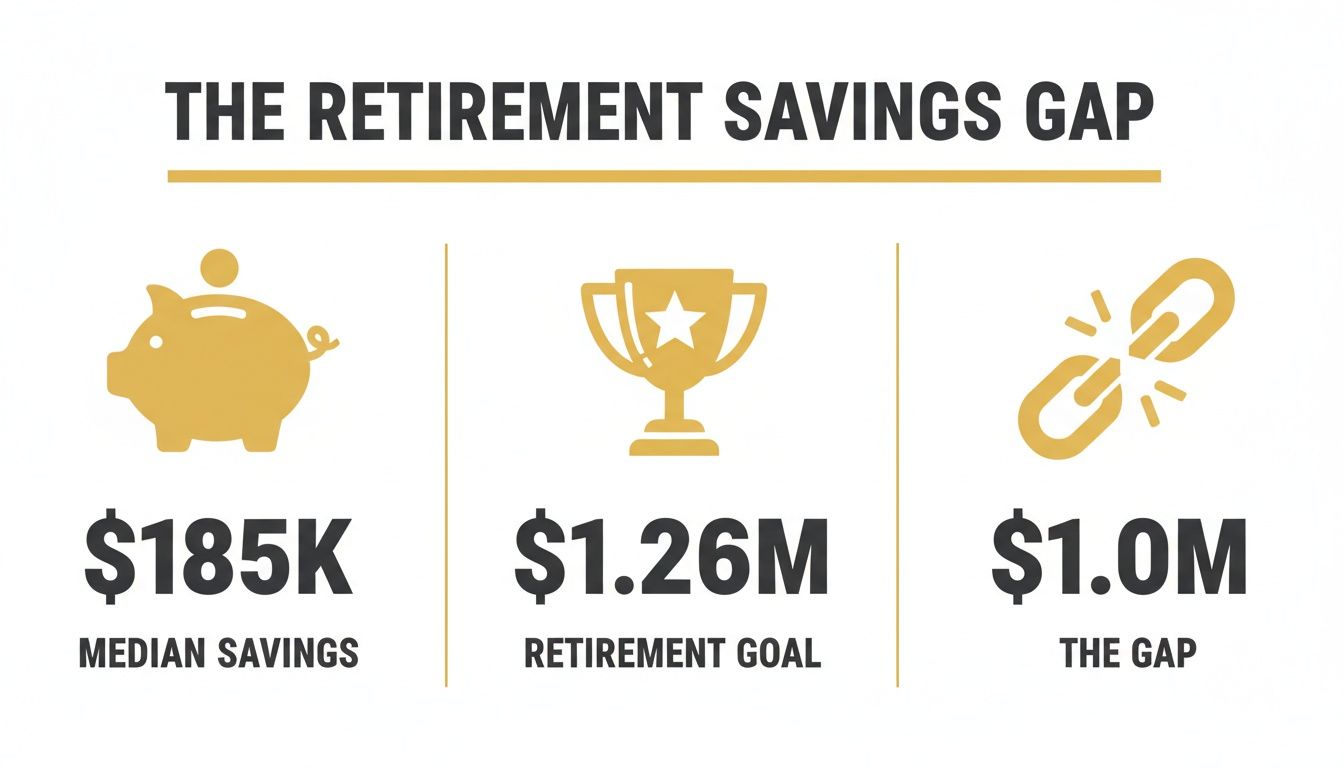
Seeing it laid out like that really underscores the urgency. It's time to build a concrete plan to bridge that shortfall.
Your Power Play For Wealth Building
While those numbers might feel a little intimidating, they should also feel empowering. If you're actively saving, you're already doing better than many of your peers. The mission now is to make this decade your most productive savings period ever. A great way to get perspective is to see where you stand by exploring our detailed guide on net worth by age and percentile.
Let’s look at a powerful, real-world example of what’s possible.
Imagine a 55-year-old who earns $80,000 a year. If they get aggressive and max out their catch-up contributions, they can sock away up to $40,000 per year ($32,500 in a 401(k) and $7,500 in an IRA).
By the time they turn 67, that strategy alone could add anywhere from $480,000 to $600,000 to their nest egg, depending on market returns. That’s a life-changing amount of money.
This isn't just about numbers on a spreadsheet; it's about making smart financial decisions that transform potential anxiety into tangible security. Acknowledging where you stand now is the first step toward building the retirement you deserve.
It’s not too late to act. In fact, your 50s are precisely the time when focused, deliberate action can be truly transformational, setting you up for a retirement you can feel confident and excited about.
Supercharge Your Savings with Catch-Up Contributions
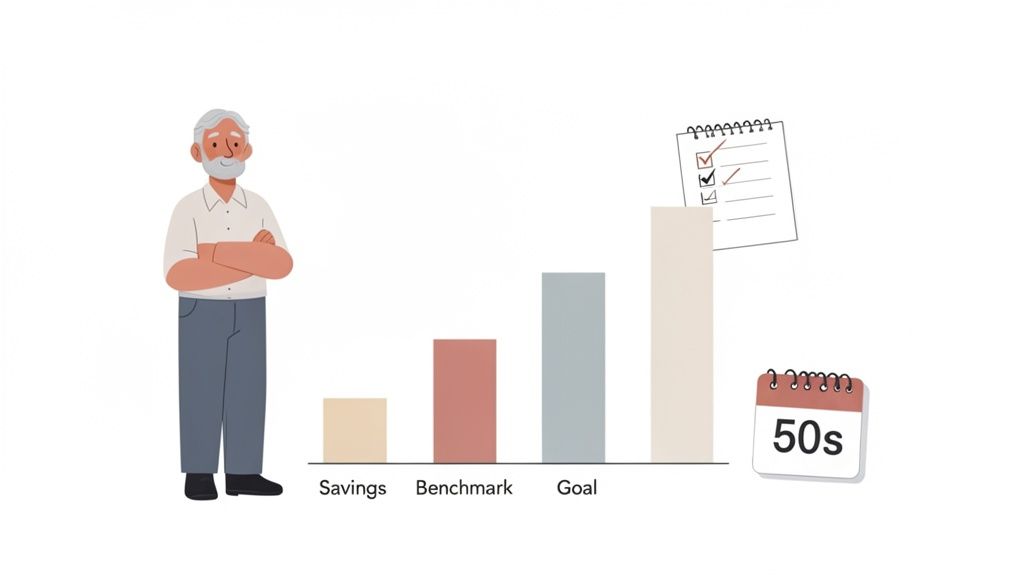
Your 50s often represent your peak earning years, which creates a golden opportunity to make some serious headway on your retirement savings. The federal government even gives you a leg up with a powerful tool designed for this exact window: catch-up contributions. These let you stash away more in your retirement accounts than your younger colleagues can.
Think of it as a financial accelerator pedal, one that only becomes available once you hit 50. It’s designed to help you close any savings gaps as you head into the final stretch. Making these extra contributions a non-negotiable part of your budget can absolutely transform your financial picture.
Understanding the Catch-Up Contribution Rules
The numbers behind catch-up contributions are pretty straightforward and incredibly powerful. While the standard contribution limits apply to everyone, turning 50 unlocks higher ceilings.
Here’s a quick breakdown of what this means for you:
- For 401(k) Plans: In 2026, workers aged 50 and over can put in the standard $24,500, plus an additional $8,000 catch-up contribution. That brings your total potential savings for the year to a massive $32,500.
- For IRAs (Traditional & Roth): The standard limit is $7,500 in 2026, but if you're 50 or older, you can tack on an extra $1,000.
- A "Super" Catch-Up: There's even a special provision for folks aged 60 to 63, allowing an even larger catch-up contribution of up to $11,250 in eligible workplace plans.
This decade is your last major shot to build a secure retirement. For a little context, the average American between 55 and 59 has a retirement balance around $284,016, but most financial benchmarks suggest you should have 8 times your annual salary saved by age 60.
The Real-World Impact of Maxing Out
Let's be honest, abstract numbers don't always hit home. So, let’s look at a practical example to see how this plays out for someone feeling a little behind on their goals.
Meet Sarah. She's a 53-year-old marketing director who makes $90,000 a year. With a $350,000 nest egg, she’s starting to feel anxious that it won't be enough. Instead of panicking, she decides to get serious about a catch-up strategy for the next 12 years until she retires at 65.
- Her Strategy: Sarah commits to maxing out her 401(k), including the full catch-up amount, for a total of $32,500 per year.
- The Result: Assuming a conservative 6% average annual return, her consistent contributions will add an extra $548,000 to her nest egg over those 12 years. That's just from her new contributions and their growth, not even counting her original balance.
By treating these contributions as a non-negotiable expense, Sarah takes her retirement outlook from anxious to confident.
This mindset shift is everything. When you stop seeing catch-up contributions as optional and start treating them as essential, you can turn a good retirement into a great one. It’s about taking control during your most powerful saving years.
The Roth vs. Pre-Tax Dilemma
As you start contributing more, a big question pops up: should you use a pre-tax (Traditional) account or a Roth account? Since your 50s are likely your highest-earning years, you're probably in your highest tax bracket, too.
- Pre-Tax Contributions (Traditional 401(k)/IRA): These lower your taxable income today, which gives you immediate tax relief. This is usually the go-to strategy for high earners who expect to be in a lower tax bracket when they retire.
- Roth Contributions (Roth 401(k)/IRA): With a Roth, you contribute with after-tax dollars, so there's no immediate tax break. The huge upside? Your qualified withdrawals in retirement are completely tax-free. This is a massive advantage if you think tax rates might go up in the future.
There’s no single right answer here—it really depends on your personal finances and what you think your tax situation will look like down the road. To get a clearer picture, explore our comprehensive guide on choosing between pre-tax or Roth contributions. It will walk you through making a smart decision that lines up with your retirement goals.
Develop a Strategic Plan for Debt and Your Mortgage
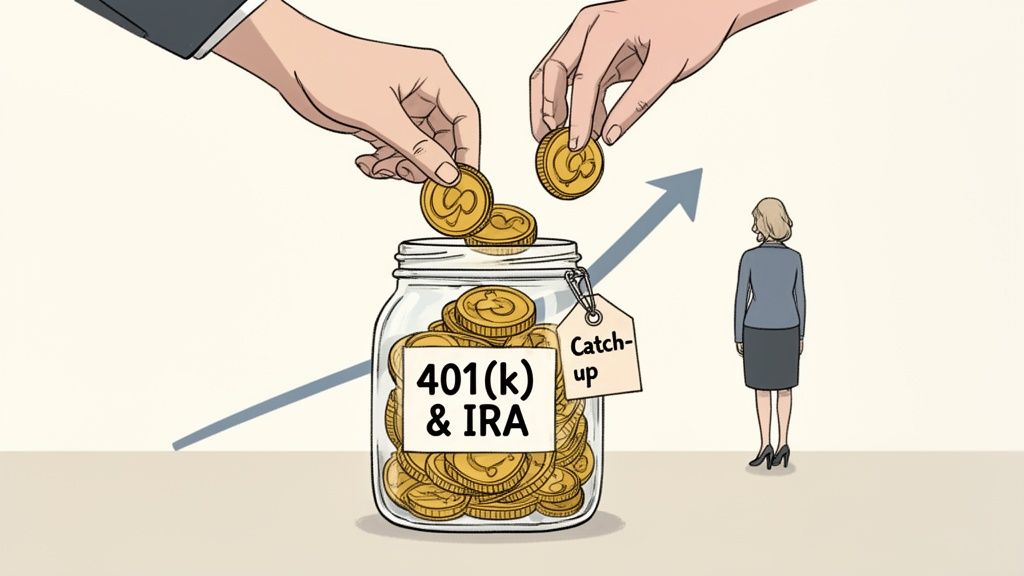
Walking into retirement with a clean financial slate is one of the most powerful feelings of security you can have. Debt, especially the high-interest kind from credit cards and even a lingering mortgage, can put a real strain on your cash flow right when you need it most. Making a deliberate plan to tackle these obligations in your 50s isn't just a smart move; it's one of the most impactful things you can do for your future self.
The goal here isn't just about getting balances to zero—it's about freeing up your future income. Think about it: every dollar not going toward a payment is a dollar you can use for travel, hobbies, or just living comfortably. A recent Harvard study pointed out that nearly half of homeowners aged 65-79 are still making mortgage payments. By getting ahead of this now, you put yourself in a much stronger position.
The Great Mortgage Debate: Pay It Off or Invest?
This is one of the most common questions I hear from clients in their 50s: Should I throw every extra dollar at my mortgage, or should I invest that money instead? There’s no single right answer. The best choice for you is a mix of math and mindset.
On one hand, it's a numbers game. If you have a low mortgage rate—say, 3.5%—and you're confident you can earn a higher average return in the market (historically around 7-10%), then investing the extra cash makes sense on paper. The growth could easily outpace what you're paying in interest, leaving you with a larger net worth down the road.
But peace of mind is priceless. For many people, the psychological freedom of owning their home outright is worth more than any potential market gain. Wiping out your biggest monthly bill gives you a concrete, guaranteed reduction in your retirement expenses. That's a feeling of stability you just can't get from a stock portfolio.
Let's look at how two different couples might handle this:
- Couple A: The Security Seekers. Mark and Susan have $150,000 left on their mortgage at 4%. They decide that being completely debt-free is their top priority. They start paying an extra $800 a month toward the principal and manage to pay off their home seven years early, just before they plan to retire.
- Couple B: The Growth Optimizers. David and Lisa have a similar mortgage but recently refinanced to a 3.25% rate. Instead of making extra payments, they invest that same $800 a month into a low-cost index fund. They'll carry their mortgage into their first few years of retirement, but they project their investment portfolio will be significantly larger as a result.
Neither couple is wrong. The best path is the one that lets you sleep at night while still pushing you toward your financial goals.
Eradicate High-Interest Consumer Debt
While the mortgage question has two valid sides, high-interest debt is a completely different animal. Credit card balances, personal loans, and any debt charging 18%, 22%, or more are financial anchors. Paying them off isn't just a good idea; it’s one of the best "guaranteed" returns on your money you'll ever find.
No investment strategy on earth can reliably beat the 20%+ interest rates that credit card companies charge. Wiping out this debt is your first and most critical step to freeing up cash flow for retirement savings.
Your first move is to create a clear payoff plan. List all your debts from the highest interest rate to the lowest. Then, attack the one at the top of the list with everything you've got while making minimum payments on the rest. This strategy, known as the "debt avalanche," saves you the most money in interest.
Need some structured ideas? Our guide on how to pay off debt faster without making more money is packed with practical tips. Once you knock out that first debt, you roll its payment amount over to the next one, creating a powerful snowball effect that will have you debt-free faster than you thought possible.
Confronting the True Cost of Healthcare in Retirement
When we daydream about retirement, it’s all travel, hobbies, and grandkids. But there’s a quiet giant looming over every one of those plans: healthcare. It’s the one expense that can silently dismantle even the most solid financial strategies if you underestimate it.
And the numbers are genuinely sobering.
A 65-year-old retiring in 2025 will need roughly $172,500 just to cover their basic medical costs throughout retirement. For those who choose Original Medicare plus a Medigap plan, those lifetime costs can balloon to a staggering $275,000 for men and $313,000 for women.
These aren't just abstract figures from a spreadsheet. They represent real-world expenses that can force you into tough choices if you're not ready. In your 50s, confronting this reality is not just a smart move—it’s absolutely critical for your long-term security. You can get more details on how these retirement costs are calculated and what they really mean for your future.
Getting a Handle on Your Future Healthcare Options
As you get closer to 65, the world of Medicare will become your new reality. The best time to start learning the lingo is now, in your 50s, so you aren’t scrambling to make huge decisions under pressure.
Here’s a simple breakdown of the main players you’ll be dealing with:
-
Original Medicare (Part A and Part B): This is the foundational federal health insurance program. Part A helps cover hospital stays, while Part B is for things like doctor visits and outpatient care. It’s a solid start, but it absolutely does not cover everything and comes with its own deductibles and coinsurance.
-
Medicare Advantage (Part C): Think of these as all-in-one plans offered by private insurance companies that bundle Parts A, B, and often prescription drug coverage (Part D). They frequently toss in extra perks like dental and vision.
-
Medigap (Medicare Supplement Insurance): Sold by private companies, these policies are designed to fill the gaps—hence the name—left by Original Medicare. They help pay for costs like copayments and deductibles. Just remember, you can't have both a Medicare Advantage plan and a Medigap policy.
The path you choose here will have a massive impact on your out-of-pocket costs for the rest of your life. Understanding the pros and cons now gives you a huge head start.
The Ultimate Tool for Healthcare Savings: The HSA
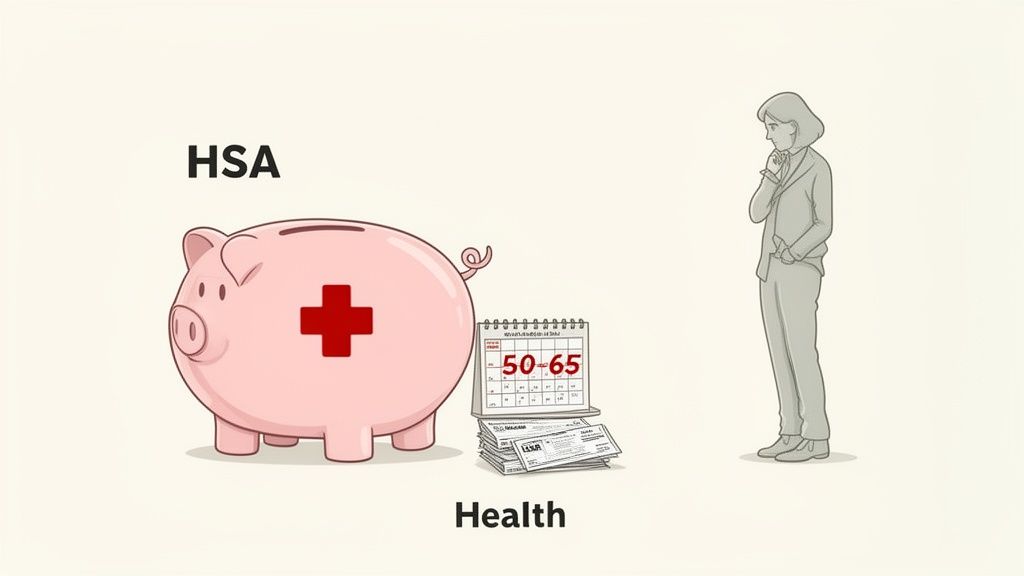
While the numbers look scary, there’s an incredibly powerful tool at your disposal to fight back: the Health Savings Account (HSA). If you’re enrolled in a high-deductible health plan (HDHP), an HSA isn't just a nice-to-have; it's a must-have for retirement planning.
Why? It offers a unique triple tax advantage that no other retirement account can touch.
- Tax-Deductible Contributions: The money you put in is tax-deductible, which lowers your taxable income this year.
- Tax-Free Growth: Your funds can be invested and grow completely tax-free.
- Tax-Free Withdrawals: You can pull money out tax-free at any time to pay for qualified medical expenses.
An HSA is more than just a healthcare account; it's a stealth retirement vehicle. Once you hit 65, you can withdraw funds for any reason—not just medical—and it's simply taxed as ordinary income, just like a traditional 401(k). This flexibility makes it an incredible addition to your overall strategy.
To make this clear, let's compare how an HSA stacks up against using a 401(k) for medical costs.
Comparing Healthcare Savings Options in Your 50s
This table breaks down the key differences between using a Health Savings Account (HSA) and a traditional 401(k) to cover medical expenses in retirement. While both are powerful savings tools, the HSA has some distinct tax advantages for healthcare.
| Feature | Health Savings Account (HSA) | Traditional 401(k) |
|---|---|---|
| Contributions | Tax-deductible | Tax-deductible |
| Growth | Tax-free | Tax-deferred |
| Withdrawals for Medical | Tax-free | Taxed as ordinary income |
| Withdrawals for Non-Medical | Taxed as income (after age 65) | Taxed as ordinary income |
| Penalty-Free Access | Anytime for medical expenses | Generally, after age 59½ |
As you can see, the HSA’s ability to provide completely tax-free money for medical care is a game-changer. The 401(k) is essential for your primary retirement fund, but for healthcare costs, the HSA is in a league of its own.
A Real-World HSA Case Study
Let's look at a practical example. Meet James, who is 55 and has a high-deductible health plan through work. After learning about the power of an HSA, he decides to go all-in.
- In 2025, the maximum family contribution is $8,300.
- Because James is over 55, he can add an extra $1,000 catch-up contribution.
- His total annual savings: $9,300.
James commits to this strategy for the next 10 years until he turns 65. Assuming a modest 6% average annual return on his invested HSA funds, his dedicated healthcare pot would grow to over $122,000.
That’s a substantial buffer to cover deductibles, copayments, dental work, or even long-term care premiums in retirement—all without having to touch his primary 401(k) or IRA. This proactive approach turns one of retirement's biggest worries into a manageable part of his plan.
Securing Your Legacy and Planning for Long Term Care
When you hit your 50s, retirement planning starts to feel different. You’re not just thinking about your own future anymore; you’re looking at the bigger picture—your family, your assets, and the legacy you want to leave.
This is the decade to have two critical conversations that are all too easy to put off: estate planning and long-term care.
Tackling these topics isn’t about being morbid. It’s about taking control. A solid plan protects the assets you’ve worked a lifetime to build, ensuring they aren’t wiped out by unexpected costs and are used to support both your future and the generations to come. It’s one of the smartest financial decisions you can make.
The Non-Negotiable Estate Plan
An estate plan is just a clear set of instructions for what happens if you can no longer make decisions for yourself or after you’re gone. And no, it’s not just for the wealthy. Everyone needs a basic plan to prevent chaos and conflict for their loved ones.
At the very least, your plan should include these core documents:
- A Will: This legal document spells out how you want your assets distributed and names a guardian for any minor children. Without one, the state makes those calls for you.
- Durable Power of Attorney: This lets you designate someone you trust to handle your financial decisions if you become incapacitated.
- Healthcare Proxy/Power of Attorney: This appoints a person to make medical decisions for you if you can't communicate your wishes yourself.
Think about it this way: I’ve seen two siblings navigate their father’s sudden passing. Because he had a clear will and powers of attorney in place, they could pay his final bills and settle his estate without confusion or arguments during an already brutal time. That plan was his final act of care for them.
Confronting the Reality of Long-Term Care
The potential need for long-term care is one of the biggest financial wrecking balls for any retirement nest egg. The costs are staggering. The national median for a home health aide is over $75,000 a year, while a private room in a nursing home can top $116,000. Facing this possibility in your 50s is absolutely crucial.
You have a few ways to tackle this challenge:
- Long-Term Care Insurance: A traditional policy helps cover care costs. The trick is to apply in your 50s while you’re still healthy, since premiums are based on your age and health. Over 30% of applicants in their early 60s get denied coverage.
- Hybrid Life/Long-Term Care Policies: These plans combine a death benefit with a long-term care rider, letting you access funds for care if you need them. They offer flexibility, so the premiums aren’t "wasted" if you never require care.
- Self-Funding: This means earmarking a significant chunk of your assets specifically for potential care costs. It requires a substantial nest egg and a disciplined strategy to keep those funds ready.
Your 50s are the prime time to explore these options. Waiting until your 60s not only jacks up the price of insurance but also dramatically increases your risk of being denied coverage altogether. That leaves self-funding as your only, and most expensive, option.
Making a conscious decision about long-term care does more than just shield your assets. It spares your children from having to make incredibly difficult financial and emotional choices for you. It puts you in the driver’s seat, ensuring you get the care you want, where you want it. This kind of foresight is the bedrock of a truly secure retirement and a thoughtful legacy.
Got Questions About Retiring in Your 50s?
As you hit your 50s, the retirement runway suddenly feels a lot shorter. It's completely normal for a flood of questions to pop up—the stakes are higher now, and the decisions you make in this decade will echo through the rest of your life.
Let's tackle some of the biggest "what ifs" and "should Is" that might be keeping you up at night. The goal here is to trade that uncertainty for confidence and give you a solid game plan.
How Much Should I Have Saved by Age 55?
You've probably seen the stats—the median savings for this age group hovers around $185,000. But let's be honest, for a comfortable retirement, you'll need to aim much higher.
A good rule of thumb many financial pros use is to have 7 to 8 times your annual salary tucked away by the time you're 55.
So, if you're making $100,000 a year, you should be shooting for a nest egg somewhere between $700,000 and $800,000.
Of course, this is just a benchmark. The right number for you depends entirely on the life you want to live, when you plan to stop working, and what you expect to spend—especially on healthcare. Your 50s are the perfect time to get serious and run a detailed retirement projection. The real key is using this decade to aggressively close any gap between where you are and where you need to be.
Should I Pay Off My Mortgage Before I Retire?
This is one of those questions that's as much about emotion as it is about math. There's no single right answer, and it really comes down to what helps you sleep better at night.
Financially, the decision boils down to a simple comparison: your mortgage interest rate versus what you could potentially earn by investing that money instead.
If you're lucky enough to have a low mortgage rate, say in the 3-4% range, you could argue that putting extra cash into the market makes more sense. Historically, investment returns have often outpaced that, meaning you could grow your net worth faster.
But you can't put a price on peace of mind. Walking into retirement completely debt-free is a powerful feeling. For many, that sense of security and a simplified budget is worth more than any potential market gains.
A popular middle-ground approach is to make some extra principal payments to pay the loan off a few years early while still consistently funding your retirement accounts. You get the best of both worlds.
What Are the Biggest Financial Mistakes to Avoid?
Your 50s are for smart, intentional moves—not for unforced errors. Getting a few key things right now can make a massive difference in how your retirement plays out.
Here are a few critical mistakes I see people make all the time:
- Getting too conservative, too early. Yes, you need to dial back risk as you get closer to retirement, but pulling out of the stock market completely can starve your portfolio of the growth it needs to last for the next 30 years and beat inflation.
- Ignoring future healthcare costs. This is a big one. Underestimating what you'll spend on medical care is one of the quickest ways to drain your savings. You have to plan for it now.
- Forgetting to use catch-up contributions. The government literally lets you save more once you hit 50. Leaving this "free money" on the table can cost you hundreds of thousands of dollars over the decade. It's a powerful tool designed just for you.
- Putting off estate and long-term care planning. Nobody enjoys these conversations, but delaying them just creates stress and confusion for your family. Tackling it now protects your assets and gives everyone clarity.
When Should I Take Social Security?
Deciding when to start your Social Security benefits is easily one of the most important financial choices you'll ever make. You can start drawing benefits as early as age 62, but doing so means your monthly check will be permanently smaller.
If you wait until your full retirement age (which is 66 or 67 for most people), you get 100% of your earned benefit.
But if you can hold off even longer, until age 70, your benefit increases by about 8% for each year you wait. That strategy locks in the largest possible monthly payment for the rest of your life.
The best timing depends on your health, family history, other sources of income, and whether you're married. For couples, coordinating your claiming strategies can be a game-changer. In your 50s, the goal is to model a few different scenarios to see how your other retirement funds can bridge the gap if you decide to delay your benefits for that bigger lifetime payout.
At Smart Financial Lifestyle, we believe that making smart financial decisions is about blending practical steps with the wisdom gained from experience. Paul Mauro’s 50+ years of expertise have shown that clarity and a well-thought-out plan are the keys to a confident retirement. To continue building your knowledge and securing your future, explore more insights and guides on our website.
Learn more and start your journey at https://smartfinancialifestyle.com.
